Sunday, March 16, 2014

Blessed are you, Adonai, Sovereign of the Universe...

Yesterday, I went to Congregation Brith Sholem, a synagogue here in Ogden. If you didn't have a chance to read the update on the pre-service blog for this, my friend who is a congregant at Kol Ami was unable to make it due to personal issues. So, I chose the synagogue closer to home. What was my first time in a synagogue like?

Atmosphere:

Brith Sholem is not located in a good part of town. I assume that it was built back when this area was nice, but as it is today, it's not prime real estate. When you first pull up to it, it's a modest brick building with white columns on the facade of the building.


But, when you enter the doors of the synagogue, you are no longer in downtown Ogden, but transported to a sanctuary of peace and simple beauty. The walls are all white, and there is a simple area when you first walk in that's used for practical purposes like social functions, keeping kippot (yarmulkes), prayer shawls, prayer books, etc.

The main sanctuary is separated from this area through a doorway. The main sanctuary is also white with red chairs lined up facing the front.


At the front of the sanctuary is a raised platform separated by a rail. Upon this platform is a piano to the right side with a menorah, the Shabbat (Sabbath) candlesticks, and flower arrangements.


Of course the most important part of the sanctuary are the bimah, a large table decorated with fine cloths used for reading the Torah, and behind the bimah is the arc, a cabinet which contains the Torah scrolls. This is the most sacred space in a synagogue and represents God's presence on Earth through the Word.


Along the walls of the sanctuary are five modern, stained glass windows. One is a window which represents the menorah and the Torah.


The other four windows represent the four seasons. This first one  represents Spring and was my favorite.


The atmosphere at Brith Sholem was very lovely and I found it to be a very pleasant gem in Ogden.

The People:

The people were extremely welcoming and kind to us. I was accompanied by two of my oldest and dearest friends, Lisa and Heather. None of us are Jewish and this was the first time any of us had ever been in a synagogue. As soon as we walked in, a nice gentleman asked us who we were, where we were from, and showed us the prayer books and explained a bit about the service. Most members of the congregation came and introduced themselves to us. The one that suck out the most to me was the president of the congregation. She seemed like a lovey and kind hearted woman. After the service she came over and talked to us about about some of the traditions of Judaism and was very kind in welcoming us back later.

The service was truly a community effort with people from the congregation of all ages participating in the service in one role or another. I really enjoyed this as it made it feel like everyone was potentially as important as the other.

The community seems very close knit and full of joy. I felt very at home and at peace there.

The Service:

The service was breathtaking. The service was lead by the student rabbi, a young woman who is going to be a great rabbi since she's already a very good student rabbi, who is doing her internship at this congregation and visits once a month.

I very much enjoyed the Hebrew hymns. It was so beautiful to hear the Psalms in their original language, and, though I don't understand Hebrew, I could tell just from how these hymns were sung that they were saturated with meaning. I actually didn't like when they started singing the hymns in English, as I felt it lost something in the process of translation.

There were a number of hymns and prayers that were said, I couldn't understand most of it because it was in Hebrew, but I did read the translations below the text a lot of the time. If you asked to now to remember a lot of what was said though, I wouldn't be able to tell you. I want to go back and learn more about this service.

The service then moved to the Torah reading. They opened the arc and brought the Torah scrolls around the congregation. Everyone either touched their books or prayer shawls to the Torah before kissing the book or prayer shall. They then read from the Torah in Hebrew. There was a melody that went along with reading each sentence that made the reading very moving.

Afterward, the student rabbi delivered a sermon. More on that in the message section.

Afterward, there were a series of prayers for various things. First was a prayer for those in the community who were sick. They mentioned a few names of those suffering with an affliction. Then the rabbi asked to congregation to name any names of people needing prayers for healing as she met their eyes. She then looked each member of the congregation in the eye and heard the names of various people afflicted with illness. A prayer was then said for healing for them.

Next were prayers for the community and nation, followed by a prayer for the State of Israel, which mostly focused on peace.

After this was a memorial prayer for those who had died. As done previously, the rabbi mentioned several names of members who had passed that they were remembering in particular, then asked the congregation to name anyone they wanted to remember. There was then a prayer for the memorial of the dead. This was, for some reason, my favorite part of the service.

After the service, there was a light potluck that I wished I could have stayed for longer, but I had things that I needed to do.

The Message:

The sermon the rabbi gave was one I related to very well. She mentioned how the reading was about Moses investing Aaron as the High Priest. As the text is sung out loud, there is a special melody used at the moment Moses is about to anoint Aaron. This melody is only sung a few other places when reading from the Torah and always indicates a moment of hesitation. Moses hesitates at this moment because in this moment, if Aaron is invested as the High Priest, Moses shall never be the High Priest and must accept another role and find his place in the community.

The rabbi then related a personal story of how when she was a teacher, she had grown fond of a student, and how hard it was to face and tell this student that she was leaving him and her profession behind to become a rabbi. She mentioned that the transition scared her, and that often our biggest changes in life come with a lot of hesitation and anxiety. But these feelings often indicate that we are moving into a path that will change us drastically, but is where we need to go. Being that my personal life is making a bunch of huge shifts very soon I related to this sermon. I think this is a message we all relate to at one point or another.

I knew before this that Jews had a complex way of looking at their scriptures, but until yesterday, I had no idea just how multi-layered it was. These melodies that accompany the readings are codified ways of adding more depth and meaning to the text. In Judaism, it seems, the words on the page and the stories within are not the end of the reading. To only see that would be the same as only seeing your face on the glass of a window and not the world outside. I feel this is something Christians need to learn from their Jewish brothers and sisters. I feel in the modern world, Christians often take a very surface level meaning of their religion and holy text. I feel there is much that could enrich them from their parent religion, Judaism.

Overall Experience:

This service was an amazing and eye-opening experience. I very much enjoyed this and would love to go back and learn more about the Jewish faith and traditions.

Additional Notes:

I did attend the Oneness Pentecostal church I mentioned in my previous pre-service blog. You can expect that blog to be up tomorrow, so keep an eye out for that.

I haven't selected a denomination for next week yet, but hopefully will have that selected by tomorrow in time for the blog post.

Until then, peace be with you.

Friday, March 14, 2014

Going to get washed in the Spirit of the Oneness Pentecostals.

The second congregation I'll be visiting this week will be New Beginnings Apostolic Church in Clearfield, Utah. New Beginnings is a member of the United Pentecostal Church International, which is a denomination of a branch of Pentecostalism called Oneness Pentecostalism.

Oneness Pentecostalism varies from other branches of Pentecostal Christianity and indeed mainstream Christianity in one very key way, they do not believe in the Trinity, but rather one God in one person. The way this is explained with them is that God is one person, the Father and the Holy Spirit are the same person, just different titles for them. The Father title refers to God's relationship to mankind, and the Holy Spirit refers to God's active presence in the world.

When it comes to Jesus, they believe that Jesus is a man who had the fullness of God dwelling inside of him from the moment of his incarnation, but that Jesus wasn't God nor a separate person within God, but a man who contained within him the fullness of God.

Like other Christians in the Protestant tradition, they believe that a person must be born again in spirit by accepting Jesus as their personal savior and receive baptism. However, unlike many other Christians of this persuasion, they believe a person can lose this salvation by backsliding back into sin. In other words, they do not believe in the concept of once saved always saved.

Like other Pentecostals, they believe in gifts of the spirit, things like prophecy, faith healing, and most famously, speaking in tongues.

According to the United Pentecostal Church International's website, members are expected to abide by a strict holiness code that includes:

  • A very strict interpretation of the Bible and its meaning.
  • Not swearing oaths of any kind (except in legal situations which is a matter of debate).
  • Practicing evangelism, in other words, proselytizing the faith and promoting it to others.
  • Sexual purity, this means no sex outside of marriage, no masturbation, and homosexuality is described as a perverse sin and those involved in it described as being caught in satanic snares. (Fun for me.)
  • Abstaining from alcohol and other intoxicants.
  • Women not holding positions of leadership. Men being heads of the household and leaders in the community.
  • Modest clothing that covers the torso and upper limbs for both sexes. Women also are encouraged not to wear makeup as it promotes lust, and to distinguish herself from men by her dress. Therefore modest dresses and skirts are encouraged. Additionally, women are told that they should keep their hair long, and men told that they should keep their hair short or be bald.
  • No use of profanity or vulgar speech.
New Beginnings Apostolic Church is a small congregation. Currently they meet in a rented space in a strip mall. In going through their Facebook page, I found them to be a small, but fairly tight knit community that makes due with what they have, using a rented space for their church, a watering trough or Jacuzzi to perform baptisms, minimal decoration.

This should be an interesting experience for me. I'm not sure how welcoming they will be. We shall see what this meeting holds.

Until next time, peace be with you.

Wednesday, March 12, 2014

שְׁמַע יִשְׂרָאֵל יהוה אֱלֹהֵינוּ יהוה אֶחָד Sh'ma Yisrael ADONAI Eloheinu, ADONAI Echad! Hear, O, Israel, the LORD our God, the LORD is One!

*** UPDATE ***
Due to some personal problems, my friend whom I was going to go with is no longer able to go. I will therefore not be going to Kol Ami Synagogue in Salt Lake, but will be attending the synagogue here in Ogden, Congregation Brith Sholem. This congregation is similar to Kol Ami in that they take from both the Conservative and Reform Traditions of Judaism. It differs in that it seems to be a smaller more humble congregation that doesn't have a permanent Rabbi and is instead run entirely by the laity of the congregation. I'm very curious to see this and will update you if there are any further developments.


Those are the most famous words in all of Judaism. They are central to the faith and said at each service. I figured there would be no better way to introduce my journey to Kol Ami Synagogue this Friday evening than to echo those words.

Congregation Kol Ami is located in Salt Lake City. It is one of the most popular synagogues in the state (of course I'm only aware of four of them). The congregation is an interesting one as it borrows from both Conservative and Reform traditions.

I am painfully aware that there is a great deal of ignorance when it comes to the Jewish faith. A lot of people in the United States don't know much about it. Therefore, I will fill in some gaps. Let's start by going over a couple things that Judaism isn't.
  1. Judaism is not Christianity. Jews do not worship, follow, nor in any way view Jesus as a central character to their religion. Period. I know this should be obvious. But it amazes me how many people I've talked to who don't know that. There is a very small group of Jews called Messianic Jews who are basically Jewish Christians. But they're a small minority and not at all representative of Judaism as a whole.
  2. Judaism is NOT just the prequel to Christianity. Christianity came out of Judaism and uses the Jewish scriptures, what the Christians call the Old Testament in their scriptures. However, Judaism does not need Christianity at all to survive, and is its own religion with over 4,000 years of rich culture and history behind it. To fail to see it is to miss out on Judaism entirely. Judaism didn't stop at Jesus, it continued on for another 2,000 years after him.
With that out of the way, let's talk about Judaism.
  • Judaism started roughly 4,000 years ago, some would argue earlier, as a tribal religion in what is called the Holy Land. Some of the seminal figures in the Jewish scriptures are: Abraham, the first monotheist, according to tradition, and the Father of the Faith; Moses, who, according to tradition, led the Jews out of enslavement in Egypt and received the Torah from God; King David, the first great King of a unified Israel; Solomon, the Wisest King; and various prophets, including Daniel; Isaiah; Elijah; and Jeremiah.
  • During biblical times, the central focus of Jewish worship was the Temple in Jerusalem. Animal sacrifice and daily prayers by priests were the central forms of worship. The Temple was destroyed for a second and final time in 70 CE (AD) by the Romans and has been in ruins ever since. Since then, Jewish worship has been centered around the synagogue, which are houses of worship and learning.
  • Jews are strict monotheists worshiping one unified God who is seen as the ruler of all the Universe and beside whom there is no other god.
  • Judaism has a number of holidays, the most well known are: Rosh Hashana, the Jewish New year; Yom Kippur, the Day of Attonement; Hanukkah, the Festival of Lights; and Pesach, or Passover.
  • There are three major sects of Judaism and a number of smaller ones: Orthodox Judaism, which is staunch in its interpretation of Jewish Law and extremely traditional; Reform Judaism, which is very liberal and seeks a Judaism that redefines itself to be relevant in the modern era; and Conservative Judaism which lies between the two.
  • The central scripture in Judaism is the Bible, or what Christians call the Old Testament. But the most important part are the first five books called the Torah: Genesis, Exodus, Leviticus, Numbers, Deuteronomy, said to be God's word to mankind.
  • The Jewish Sabbath is not on Sunday like the Christian one, but is on Saturday and begins Friday night at sunset, hence why I am going to services Friday evening.
  • Concepts of the afterlife are not concrete in Judaism. Some Jews believe in an afterlife, some do not. Similarly, some Jews anticipate a messiah and the resurrection of the dead, and some Jews do not.
As I said before, the congregation I am going to takes from both Conservative and Reform traditions, which I think will be an interesting blend to see. I'm quite excited as I have never been to a synagogue and would love to experience it the rich heritage Judaism has expressed for a modern era. I am going with a friend who is a congregant there, so hopefully I'm not too much a fish out of water.

I will let you know how everything goes.

Until then, peace be with you.

Sunday, March 9, 2014

Not the Mormonism of my childhood

This morning I went to The Community of Christ (formerly known as The Reorganized Church of Jesus Christ of Latter Day Saints) church here in Ogden. So, what was the experience like at the other Mormon congregation?

Atmosphere:

The Community of Christ church of Ogden is not a big meeting house like you would see in LDS churches on every corner in Utah, nor is it an ornate church filled with stained glass and modern architecture. Instead, it's a quaint little church looking like it's transplanted straight from New England into the Ogden Valley.

The exterior is a gorgeous whitewashed wood with Gothic arched windows. It was quite unexpected to see anything like this in Ogden. I actually shouted out when we pulled up, "Oh, it's so adorable."


When you walk into the building, the first thing you see is the chapel. The chapel is nothing like any LDS chapel I have ever seen. Again, it looks like a simple, quaint church from New England. There is a cross crowned with a crown of thorns, a handsome picture of Jesus next to that, the pulpit in the center, and a communion table off to the right side. There are decorations all along the wall, mostly of the hands of Jesus, or paintings from the life of Jesus. 

Growing up, LDS churches all felt very manufactured to me. They all had similar floor plans, the same mass printed paintings, the same sort of furniture, there was never any variation of anything. Nothing in this chapel felt like it was pre-selected by some committee from a catalog, but felt very organic and alive.


The communion table was quite interesting. It was covered in a purple cloth and on it was an earthenware chalice and an animal horn. I was curious whether it was a shofar, a traditional Jewish instrument used in biblical and modern times in certain Jewish worship services. Indeed it was one.


Also on the communion table were a bunch of nails. More on that later.

Directly in front of the pulpit is a table with a cross on it and an oil lamp that is lit during the service. A lovely touch that I enjoyed very much.


Overall, the atmosphere felt homey and welcoming.

The People:

This is so far the smallest congregation I've visited. The congregation was mostly made up of elderly people save me, my friend Austin, and the granddaughter of one of the pastors who was in her teens. There weren't even a dozen of them, but from what the speaker today said, they were missing some people today who were off on a service project and a few who couldn't make it due to personal issues.

This congregation is very close-knit and very friendly. Everyone came up and introduced themselves to us. A few asked why we were there and seemed really receptive to the idea. The pastor I had emailed previously had came to introduce herself to us and was very glad welcomed us to the church.

I am not sure of the official function of the man who led the service today, but he was quite an amazing man. He is extremely well educated in religion and openly gay. He is married to the associate priest at Glory to God Catholic Church in Ogden (an Old Catholic church which is on my list, so stick around for a review on them).

The congregation was quite relaxed. There was no dress code, people had tattoos, the younger girl had gauged ears, nobody seemed to mind us being there, it was lovely.

The people overall were wonderful.

The Service:

I was more surprised by this service today than I have been by any service thus far. I was expecting something akin to my LDS childhood services, but slightly more cosmopolitan. This service had no real resemblance at all to it.

The service was an invitation to Lent. This was the first thing that really surprised me. The LDS do not have liturgical seasons. Lent is something completely foreign to the LDS Church. In fact, most LDS Mormons you'll meet will not have any idea what Lent is. The speaker gave a great talk on Lent, more on that in "The Message" section.

Apparently there is a wide spectrum of church practices in the Community of Christ, from very high churches that even go so far as distributing ashes on Ash Wednesday, to churches that have no liturgical calendar of any kind, much like the LDS Church. I like that they have a wide range of expressions as it allows the Church to adapt to local tastes and preferences.

The service began with a hymn about Lent called, "Glory of These Forty Days."

After the hymn, the speaker began a traditional call to worship from the Book of Hosea and punctuated it by sounding the shofar. That was quite a cool thing for me to see and really set this service apart from many other.

Afterward there was an opening prayer given by a member of the congregation. The prayer sounded like a standard Mormon prayer I grew up with, with "you" and "your" being substituted for "thee," "thou," and "thine." The prayer was addressed to Heavenly Father and closed "in the Name of Jesus Christ" with an "amen" afterward.

Then the speaker gave his message.

After the message, there was the Church's daily prayer for peace. This is done in the main temple of the Community of Christ every day, and they choose a different country to pray for each day. It is mirrored by each congregation apparently on Sundays. Today's prayer was for Austria, which included a little information about the country, and a prayer that they and all the world may enjoy peace. I absolutely love this practice. I think it should be incorporated into everyone's lives on earth. Not necessarily a prayer, but a daily reminder that we strive towards peace and what we can do for that. If everyone on Earth had a constant reminder of peace, how different could this world be?

After the prayer for peace, there was a community prayer where the speaker asked members to give him their concerns and joys. He wrote all of them down as they were brought up to him, then he said a very heartfelt prayer about all of the joys and concerns of the community. I loved how on the spot it was and how it involved the community and their immediate concerns.

The female pastor then got up and gave an invitation to Lent and a litany for repentance was said, which included the famous words of Jesus that there are only two commandments, love God with all your heart, mind and soul, and love your neighbor as you love yourself. Besides these, there are no greater commandments. I wish more Christians felt this way and didn't focus on all these tangential things like who's being moral and who's not, or accumulating wealth or power.

We sang another hymn afterward. The hymns were lovely. There was a lot of diversity with them. Several were about Jesus, one was a traditional part of the Catholic Mass, the Kyrie, and the one sang at the very end was a traditional Jewish hymn called "Shalom Charavim." It was explained to me that they are a world church, and being a world church doesn't mean that they simply translate their hymns into other languages, but they take the hymns of other cultures of other peoples in their church and incorporate them into the tapestry of their body.

The service ended with all of us gathering around the communion table. Not for communion, but so that the speaker could lead us in a fascinating ceremony I had never seen before. There were a bunch of nails on the table, each with a purple ribbon (the color of Lent) tied around them. Each member of the congregation passed a nail to one of the others asking them to forgive them and to pray for them. As the Lenten season goes on, members are to keep the nail with them as a reminder of their duty to forgive and their hope of being forgiven. Then on Maundy Thursday (the Thursday before Good Friday) they are all going to nail their nails into a cross as a symbol that Christ takes away all burdens.

Here is my nail from the service:

 
Overall, this service was an amazing surprise and I felt very alive and touched by many parts of it.

The Message:

The speaker's message was lovely. He talked about the tradition of Lent and how it had developed in early Christianity. He spoke with a great deal of clarity and authority on Christian heritage. He also explained that Lent is a newer tradition in The Community of Christ, but one of great importance to him and one that can be quite enriching. The focus in their Church isn't on you being a wretched sinner, but a person created in God's image, so occasionally, it's good to evaluate yourself with a critical eye and see where you can improve.

Later, he talked about where the church donations were going to help the community at large. This church places a huge emphasis on community improvement and world peace. On that note, I snapped this picture of a banner in the basement of the church. There were little things like this everywhere:


Their church has lofty goals for such a small denomination. They have set out a goal to eradicate poverty, hunger, and conflict throughout the world. They are interested in bringing the peace of God's Kingdom to here and now, not on some distant Day of Judgment.

The speaker put it best when he said, "The mission of Jesus isn't to force a bunch of people to sit in a building in straight rows and tell them what to believe, but to go out and make a difference in the community."

I love this message. This denomination isn't as much concerned with your beliefs as how you treat people in the here and now and what you do to make this a better world. To this I say, "Amen, let's have more Christians and people of all creeds or lack of belief like this!"

Overall Experience:

This church was one amazing find and a gem among denominations. They are obsessed with peace in a way I think more people need to be and strongly committed to making this world a better place. The service was very real, very emotional, and filled with love.

This church felt like nothing from my childhood, and I wish that this had been the Mormonism of my childhood rather than the strict and often lifeless expression I received. The only real resemblances I saw were a couple references to Mormon scripture in the bulletin, one reference to a member of their Church's Presidency, and the opening prayer which sounded similar to the prayers of my Mormon childhood. The rest was unique and I loved every moment of it.

Additional Comments:

This next week I will be visiting two different faith traditions. Next Sunday, I will be visiting a church, though I have yet to determine the denomination. This Friday will be a brand new experience for me as I go to Kol Ami Synagogue in Salt Lake City.

Until next time, peace be with you.

Wednesday, March 5, 2014

Off to see the other Mormons, the Community of Christ, formerly known as The Reorganized Church of Jesus Christ of Latter Day Saints.

This past weekend, I went to the Church of Jesus Christ of Latter-day Saints. What people don't often know about are other branches of Mormonism. They often might know about the small polygamy groups like the Fundamentalist Church of Jesus Christ of Latter-Day Saints (FLDS). But there is another branch of Mormonism often overlooked by both the media and Mormons alike, the Community of Christ, formerly known as the Reorganized Church of Jesus Christ of Latter Day Saints.

In a previous blog, I mentioned how Joseph Smith Jr. founded a church called the Church of Christ. During Joseph's lifetime, the Church changed it's name several times finally settling on the name The Church of Jesus Christ of Latter Day Saints.

After Joseph Smith died, there was a huge problem the community faced. Joseph had not appointed anyone to lead in his place, and there was no prophet to guide the people. A large number of Mormons believed God had chosen Brigham Young to lead the Church and followed him to what is now Utah. However, a number of Mormons stayed behind, not believing Brigham Young was a prophet. Two of these included Joseph Smith's widow, Emma Smith and their son Joseph Smith III. Many believed that Joseph had selected his son to be his successor, but Joseph Smith III was a child at the time. The Mormons who stayed behind were disorganized in several offshoot groups and individuals with no claim to any group.

In 1860, many of the disorganized entities came together and selected Joseph Smith III as their leader who accepted the position after feeling he had received revelation from God to do so. Consequently Emma joined as well. Originally the Church claimed the original name of the Church founded by Joseph Smith Jr., The Church of Jesus Christ of Latter Day Saints, but they eventually changed their name to the Reorganized Church of Jesus Christ of Latter Day Saints to distinguish themselves from the Mormons in Utah.

The Church has continued on since then and currently has 250,000 members worldwide. In 2001, the Church officially renamed itself the Community of Christ in an effort to more clearly define the mission of the Church.

Though the Church of Jesus Christ of Latter-day Saints and the Community of Christ share the exact same origin, they are quite different churches today.

Differences between the LDS Church and the Community of Christ:
  • The LDS Church believes in the Godhead, not the Trinity. That is that God the Father, Jesus Christ, and the Holy Ghost are three distinct entities but one in purpose and each Divine. The Community of Christ on the other hand affirms belief in the Trinity like other mainstream Christian Churches.
  • The Community of Christ never practiced polygamy nor believed that it was a divine institution as the LDS Church did until 1890.
  • The Community of Christ is more socially liberal than the LDS Church. They ordain women, have an open dialogue on gay rights issues, including gay marriage which is allowed in certain areas where it's legal.
  • The Community of Christ operates two temples, the first Mormon temple ever built, the Kirtland Temple, now mostly used as a historical site, and their main temple in Independence, Missouri. Unlike the LDS Church, the temples are open to the public and contain no secret ceremonies, but instead are used for common worship, and a prayer for world peace is said every day at their main temple.
  • The Community of Christ doesn't believe in eternal marriage.
  • The Community of Christ doesn't practice baptism for the dead.
  • The Community of Christ uses the cross as a symbol of their faith. The LDS Church views the cross as a symbol of torture and death.
  • There is no concept of exaltation (the belief that men will become gods in the afterlife if they are righteous) within the Community of Christ. Instead, they hold to traditional Christian beliefs of salvation. This also excludes the view of multiple kingdoms that people will go to after the Last Judgment like you see in the LDS Church.
  • The Community of Christ has no official translation of the Bible it prefers to use like the LDS Church does with the King James Bible.
  • The Community of Christ publishes a traditional language Book of Mormon as well as a contemporary language edition.
  • The Community of Christ recognizes the Bible, Book of Mormon, and the Doctrine and Covenants (though a different edition than the LDS version) as scripture. However, they do not accept the Pearl of Great Price.
  • The Community of Christ officially engages in ecumenicism and interfaith measures. The Church has abandoned the view that it is the One True Church like the LDS Church claims and instead believes it is a true church and one that receives revelation from God through prophets.
Differences between The Community of Christ and Mainstream Christianity:
  • The Community of Christ shares a similar leadership structure to the LDS Church. The Church is run by a prophet who also acts as the president of the Church and assisted by two apostles who advise him, this group is known together as the First Presidency. Below them is the Council of Twelve Apostles, and below them are several other councils and groups.
  • The Community of Christ acknowledges two other books as scripture outside of the Bible, The Book of Mormon and the Doctrine and Covenants. They view the Bible as the foundation of scripture and revelation, and The Book of Mormon and Doctrine and Covenants as additional testimonies of Christ.
  • They believe in continuous revelation through prophets, but also personal revelation to members of the Church.
  • The Community of Christ has a formal priesthood which they trace back to Joseph Smith and in turn Jesus Christ. This Priesthood is made up of two orders, the lower, Aaronic Priesthood, and the higher Melchesidek Priesthood. Both men and women may possess this priesthood and it is seen as essential to the life of the Church.
There are only three Community of Christ churches in Utah that I'm aware of, one in Salt Lake, one in St. George (at the very southern edge of the state) and one here in Ogden. The one in Ogden I'm certain is probably a small and humble church. I emailed the pastor about the times and they seemed happy that I am coming.

This should be an interesting experience for me, and I'm curious to see how different and how similar it is to the church services of my childhood.

Until next time, peace be with you.

Monday, March 3, 2014

More on the Mormons and my trip to Salt Lake City

Here are some additional comments about the experience:


Here are my pictures of the Cathedral of the Madeline which I mentioned in my video.


The high altar, behind it, the Cathedra (bishop's throne) of the Bishop of Utah. Behind that is a chapel which houses the church's tabernacle, the tomb of the first bishop of Utah, and a relic of Mary Magdalene (dubious at best.)


Stained glass window depicting the resurrection of Jesus.

And here is a picture of the Danish Lutheran church I will never get to attend because they moved and merged with the ELCA.


Sunday, March 2, 2014

The Saints Testify

Today, I went to fast and testimony meeting at the Church of Jesus Christ of Latter-day Saints. As I mentioned in my previous blogs, this is me returning to the church of my childhood for one of the services. I also mentioned that I still carry a lot of emotional baggage with this Church. So, did the service uplift me, or stir up a lot of old emotions?

For those not familiar with Mormon terminology, I use the word, "ward" a lot in this entry. A "ward" is basically a Mormon congregation.

Atmosphere:

Okay, to start, I didn't just go to the local church meeting house. I thought about it, but then I thought, I live in Utah. Temple Square is here within driving distance. If I'm going to only go to one LDS service the entire year, I might as well go to the Mormon Vatican since it's basically right in my backyard.

The day started with a tour of Temple Square. Here are some highlights.

We started at the Church History Museum. The first thing you see on the tour are these lovely stained glass windows depicting Joseph Smith's First Vision. As someone who used to work in a stained glass studio, this quite impressed me.


There were a few other cool artifacts in that museum such as:


This cross stitch from Africa that says, "The Mormon creed is to mind your own business."


This recreation of an early Mormon chapel. I wish they still looked like this. This is quite beautiful.


This old sealing altar from the Manti Temple. For those of you who don't know what this is, when a couple is married in the temple, they believe they are getting married for all eternity. They kneel across from each other at altars like this one holding hands and exchanging vows in a simple ceremony.


This replica of the Angel Moroni statue that sits atop the Salt Lake Temple. The Angel Moroni is believed to be the angel that revealed the Gold Plates to Joseph Smith who translated them into the Book of Mormon.


One of the old pulpits used by the prophets of the Church. Here I am standing behind it.

And for fun, here I am delivering a hell fire and damnation sermon. I've always wanted to do that from the pulpit.


But probably the thing that impressed me most in this museum were the replicas of the death masks of Joseph Smith and his brother Hyrum. You can actually see what the face of the founder of this faith looked like. Joseph is on the left, Hyrum is on the right.


Afterward, we went through Temple Square. I caught this picture of the Salt Lake Temple, the iconic symbol of the LDS Church.


And I took a picture of this, but it didn't save, so I am using my friend Austin's picture of the famed Christus Statue celebrated by the LDS Church, but also several other Christian denominations that have replicas of it. The original is in the National Cathedral of Denmark called Our Lady's Church.


We then made our way over to the Joseph Smith Memorial Building for Sacrament meeting. The downtown wards in Salt Lake don't have a church building to meet in and there isn't really much room to build one. So they meet in the Joseph Smith Memorial Building. The building used to be a hotel, but the Church turned it into a tourist site. In this building is a cafe, an auditorium where they show church videos daily except Sunday, it's also used as a reception hall for weddings, and several other functions.

The building is gorgeous inside. My friend Reed who accompanied me said, "Well, you know how to pick the places, don't you, Chad?"


I also snapped this picture of my friend Reed sitting in this fancy chair in the lobby. We called it his throne.


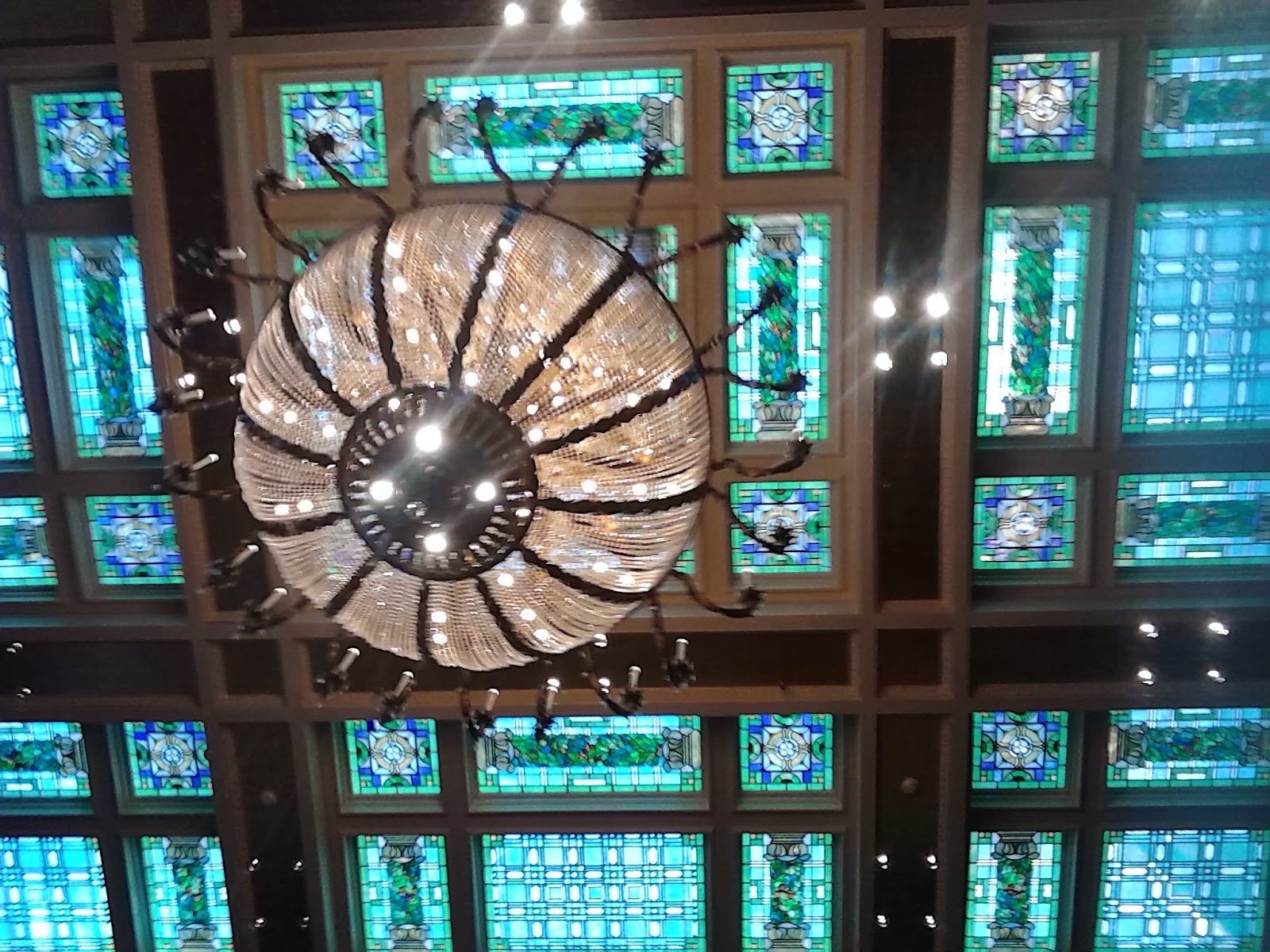
The chapel itself was the most beautiful Mormon chapel I've ever seen. It obviously used to be a ballroom. The room was white with green carpet and seats. The ceiling looked like something out of a baroque palace, and there were pilasters topped with gold and white fruits and golden leaves.

I got a good picture of the ceiling. I tried to get a good one of the chapel's pulpit, but I was trying to be discrete and it came out blurry. I am still sharing it, hopefully you can get the idea.


This chapel is atypical of LDS chapels. Most LDS chapels are whitewashed, have no decoration to speak of, no artwork on the walls, no crosses (Mormons don't like crosses. They see them as symbols of death and torture.), and no real accents of any kind. With a few exceptions, churches built in the second half of the twentieth century and beyond all follow the same sort of pattern. In fact, every church built within a certain decade will be built on one of several pre-approved floor plans. There isn't much diversity in LDS churches. They put all of their creative resources into their temples which are all different and filled with the finest materials the Church can provide.

The People:

This church was also atypical in another striking way. Mormon churches, especially ones here in Utah, tend to be filled with families with lots of children. Usually there are many children in Sacrament meeting, often being shushed by parents. This ward however only had a few families. This was a type of ward I had heard about growing up. They call this type of ward a "newly weds and nearly deads" ward. This is a very irreverent term for wards comprised mostly of elderly people and young newly wed couples who haven't yet had children.

This was first apparent to me when I saw few children or teens in the ward, and when I saw adult men preparing, blessing, and passing the Sacrament (Mormon communion). Typically, young men between 16 and 18 bless the Sacrament, young men between 14 and 16 prepare the Sacrament, and boys between the ages of 12 and 14 pass it to members of the congregation.

As far as the people and how they reacted to us, not one person in the ward approached any of us and talked to us. Only one person approached us, and that was an elderly missionary in the lobby of the building who basically wanted to make sure we weren't tourists and were there for the service. I got the impression we were being watched by several people in the congregation who all wanted to know why we were there.

There is no social hour after a Mormon service, nor before. Members of wards are pretty tight knit, outsiders visiting often feel like they're not welcome, though this isn't necessarily the case. Today, I did feel pretty unwelcome. It felt as though some of the older members in particular didn't really want us there.

The Service:

The service was very typical of an LDS service. They began with the bishop giving announcements. Then there was an opening hymn and a prayer. The woman who gave the prayer was clearly feeling it and not just going through the motions. I haven't heard a public prayer in a Mormon church before with such emotion behind it.

Afterward, they blessed and passed the Sacrament to the congregation. Mormon Sacrament consisted of sliced wheat bread torn into little bits and tiny plastic cups of water that could be disposed of. No, I didn't partake. Mormons practice closed communion and I am officially no longer a member of the Church.

Afterward, they opened the pulpit up to testimonies. More on that in "The Message" section.

After testimonies, they ended with a hymn and a prayer. I have never liked LDS hymns. The Mormon Tabernacle choir has lovely arrangements of these hymns, but the ones sung in Sacrament meeting are watered down, monotonous, and lifeless. Often it's hard to tell the difference between hymns. I would like to see more lively hymns in their church, which can be done in a traditional style still, as we see with the Mormon Tabernacle Choir.

Overall, the service left me wanting more out of it. It was very uninspired and unmoving to me.

The Message:

Here was where I had a few issues.

The bishop began testimonies by giving his testimony. He said a couple things that really bothered me. He talked about encountering Catholics on his mission when he was young. He mentioned that Catholics didn't read the Bible because they were taught not to and that it was forbidden by the Catholic Church and that a priest had to interpret it for you and give you the true meaning. This is a blatant lie. Catholics are not discouraged from reading the Bible. They are in fact encouraged to read it. As a Catholic convert, I was given a Bible to study, told to read it, joined a Bible study group offered by my parish, and Bible passages are read at every single Catholic service. The fact that this bishop, a man in a position of authority was making this claim to members who would readily and easily believe it really upset me.

He also said he read the whole Bible and found it very uplifting. I have a hard time believing he actually read it cover to cover as he mentioned if he found it uplifting. I have never met anyone who has done that and found the experience uplifting. It usually inspires many questions, doubts, and tests one's faith. Even the devout Christians who truly believe I know who have done so say it was a challenging experience but one that brought them to a level of deep faith. Not one person I've known has said it was uplifting, but they have all said it was rewarding in one way or another.

A lot of the testimonies were similar, sharing life experiences, people who clearly had fallen on hard times and needed the Church to give them meaning of it all or get through it, people who were grateful for what they had, etc.

One thing that really bothered me was the woman who brought her daughter up to bear her testimony. It bothered me as a Mormon, and it bothers me now. Children can't have a testimony of the Church and know it's true. They are small children. They don't understand what the Church is, what it really teaches, or the concept of belief and doubt. They simply parrot what their parents tell them to and this is wrong. Let the child be a child and discover what they believe and want as they grow up. Do not force them to make public statements of faith when they have no real concept of it.

Overall Experience:

I am glad I did this, because it allowed me to see some of my past. But I will not be returning to an LDS Church anytime in the near future. This was too hard for me and made me feel very awkward. I am not inspired by these services, and personally find them boring. I am glad that others find lots of meaning in them, but it is not something I could ever believe in again, and it is certainly not where I want to be.

Additional Comments:

I will be adding another blog sometime this week commenting more on my trip to Temple Square and the LDS Church in general. Join me for that.

Next week I will be going to the Community of Christ, formerly known as The Reorganized Church of Jesus Christ of Latter Day Saints.

Until next time. Peace be with you.