Showing posts with label Salt Lake City. Show all posts

Monday, December 1, 2014

Sunday with the Sikhs

Yesterday, I was going to go to the Mennonite church in Tremonton, Utah. However, it proved nearly impossible to contact the Mennonites to find out when their service times were and they don't have a website. So, I considered alternatives, and after ruling out many churches which would seem like deja vu, I opted for a religion I hadn't considered attending before: Sikhism. It seems odd to me that I would overlook this relatively large religion that comes out of India, especially since I looked into other much smaller religions.

History of Sikhism:

While Sikhism is a major world religion, it's not well known in the West. Sikhism started in the early 16th century in the Punjab region of what is now India and Pakistan. Guru Nanak began the religion after rejecting both Hinduism and Islam, the two dominant religions of the Indian Subcontinent.

After Guru Nanak died, there were 9 additional gurus which followed him. The 10th and final guru, Guru Gobind Singh, was a heavily influential guru. He compiled a the scriptures of the Sikh people, known as the Granth, and declared that after him there would be no other human guru, but instead the Granth would be the Eternal Living Guru. As such, the Sikhs now refer to their scriptures as Guru Granth Sahib, roughly meaning the Master Guru Granth.

Guru Gobind Singh also created the Khalsa, a religious and military order all initiated Sikhs belong to. The Khalsa acts to defend the Sikh people and faith as well as act as a community for fellowship. In times past, the Sikhs did face actual military violence from both Hindus and Muslims in the region who wanted to wipe them out. Therefore, the Khalsa served much more than a ceremonial function being a military organization, but served as a real life defensive military to which all Sikh people belonged.

Today, Sikhs still largely remain in the Punjab region of India and Pakistan; however, many exist in other countries worldwide including large pockets in the United Kingdom and the United States.

Beliefs and Practices of Sikhism:

  • Sikhs are strict monotheists. Sikhs believe in one God who is without form or gender.
  • Sikhs believe that all mankind has access to God without the need of an intercessor.
  • All are equal before God, regardless of gender, creed, background, caste, etc.
  • God's presence can be seen everywhere and in all things. They believe God resides in all of us, therefore, good exists in all of us no matter how wicked we seem and thus all are able to change.
  • Sikhs believe in reincarnation and Karma like Hindus. That is that ones actions lead to cosmic consequences from one life to another. Sikhs believe that the ultimate goal is to liberate oneself from this endless cycle of rebirth and join entirely with God.
  • Sikhs believe that God's grace liberates mankind from the endless cycles of rebirth. Sikhs, similarly to Protestant Christians, believe that this cannot be earned by mankind. However, they do teach that living righteously helps mankind draw closer to God which allows God's grace to reach them.
  • Sikhs are bound to do three things: keep God in mind always, earn an honest living, and charity.
  • The following are considered vices which obstruct our relationship with God and continue us on the constant cycle of rebirth: lust, greed, attachment to material things, anger, pride.
  • In addition to these vices, Sikhs also do not participate in nor financially support gambling, alcohol, drugs, or tobacco.
  • Sikhs will only go to war for self defense.
  • Sikhs perform weddings, funerals, and baby blessings.
  • Sikhs are initiated into the Khalsa (Sikh community) through a baptism ceremony called the Amrit Ceremony, which involves them drinking a mixture of blessed sugar water and being blessed with the water.
  • Sikhs which have undergone the Amrit Ceremony are required to wear the 5 K's as a sign of their commitment. Men and women both wear these items. The 5 K's are ceremonial things which distinguish Sikhs as members of the Khalsa and must be worn at all times for the rest of their lives. The 5 K's are:
    • Kesh - Uncut hair on the head and body. This hair represents accepting what God has given you as it is and also represents adopting a simple lifestyle. Because of the need to keep their long hair clean and tidy, Sikhs wear a distinctive turban on their heads.
    • Kangha - A wooden comb carried with the person representing grooming and caring for God's body which has been given to you.
    • Kara - A steel bracelet which represents servitude to God.
    • Kachera - Cloth underwear which look like boxers with a draw string. This represents chastity.
    • Kirpan - A sword or knife representing a willingness to defend those in peril and the faith.
  • Sikhs do not seek converts but welcome those who wish to convert.
  • Sikhs strive to live in harmony with people of all ethnicities, creeds, castes, gender, background, etc.
  • Sikhs do not have priests. Anyone from the community who is able to do so may lead the services.
  • Men and women are seen as equals in Sikh society. Women are allowed to lead the services and fully participate in all aspects of religious life and have been allowed to since the beginning. They are not seen as spiritually inferior to men.
  • Sikhs don't believe in ritual and blind ceremony. Therefore they do not have a set liturgy, candles, bells, religious artwork, or incense, nor do they fast or make pilgrimages.
So what were the Sikhs like?

Atmosphere:

The Sikh temple is located in Taylorsville, Utah, a suburb of Salt Lake City. My phone was acting up, so I couldn't get a picture of the outside of the temple. It's located next to a strip mall and is a fairly basic white bricked building which says Sikh Temple of Utah on a blue awning over the doorway and several smaller blue awnings over the windows with Punjabi writing on them.

When you first walk in the doorway, there is a little area with cubbies to put your shoes in. Sikh customs state that you must remove your shoes and cover your head when you enter the temple. So we took our shoes off and placed them in the cubbies. We then walked over to the box which had bandannas and other head coverings you could borrow. By the time we got to it, all of the good head coverings had been taken and we got the left over rags. After picking through a few, I found a goldenrod colored bandanna that was a little tattered but in decent shape. I put it on and my friend said I looked like a bar wench. But I found the experience kind of fun.

Just past the foyer for your shoes were two sets of stairs, one leading up and one leading down. It was unclear which we were supposed, but most of the activities seemed to be taking place upstairs. So we followed a couple people upstairs and ended up sitting by a group of men in the back.

The main hall was a large room with two large crystal chandeliers. Everyone was sitting on the floor cross legged. There were clusters of women sitting together and men sitting together, but no clear distinction that they had to be separated.

At the front of the hall were two main areas, a raised platform with a band playing bongos and sitar music with another man chanting out hymns and scriptures in Punjabi. Occasionally, the words of the hymns would be projected on a screen behind him with an English translation. On the other side was an ornate altar with a blue canopy over it. The altar was a raised platform with a table covered in an expensive pink and white cloth. On this altar is a copy of their scriptures, the Guru Granth Sahib. This is the holiest part of the temple and should be treated as though you were in the presence of a living breathing guru. Directly before this are a series of small platforms that have a number of Khandas (several interlocking swords, the official symbol of their faith) and a few swords. People would leave offerings on these platforms throughout the service.


Overall, the atmosphere was interesting. It didn't feel much like a house of worship so much as a large contemporary building with an altar in the front. It sort of reminded me of an Indian version of an Evangelical church with the area for the choir with a projector screen and simplicity of design.

The People:

Most of the people were Indian or of Indian origin. Most of the women were wearing traditional Indian clothing like the saris and head coverings, all very colorful and ornate. The men were mostly wearing traditional western clothing, but had beards and turbans on their heads.

Few talked to us, a couple of people at the end gave us some pamphlets, said they'd be happy to answer any questions if we had them. I asked if we could take some pictures. They said that we could absolutely take some and even had a man pose for the picture I took above. Had my phone not been acting up, I would have taken a few more pictures.

Overall, not a very talkative bunch, but very warm and kind to us nonetheless.

The Service:

There will be no message section of this blog. The reason why, every word of the service was in Punjabi, so I have no idea what was said. When we first came in, they were playing music on the bongos and sitar and someone was chanting along. We sat and a hymn was playing talking about the death of Guru Nanak. The lyrics were pretty talking about how everyone was mourning when he went away.

After that, the man who had been chanting said something for nearly 45 minutes. I have no idea what he was saying, but while he was talking, another man was accompanying him on the bongos.

They then sang another hymn about what your mother's ultimate desire would be, that you remember God all the days of your life. After this, everybody stood and recited a prayer together. At one point in the service, everybody knelt and touched their head to the ground as Muslims do in their worship, before they stood up again.

Once the prayer was over, everyone sat back down on the floor and the man who had been chanting went up to the altar and uncovered the Guru Granth Sahib. He opened it to a random page and began reading from it. This apparently is a tradition and it's decided from randomly opening to that page it is what the lesson of the day should be. 

After that, a group of men went and washed their hands. While they did that, children went around handing napkins to everybody. The men then came around with bowls giving handfuls of something to everyone. I learned later that this stuff is called Karah Parshad and it's a mixture of equal parts semolina, clarified butter, and sugar. It is blessed and symbolizes hospitality and should be taken as though it were given directly by God or the Guru. To turn it down is one would be quite an offensive thing to do. It was rather tasty and I enjoyed eating it.

After the service is a community meal. This meal is an important symbol of charity and Sikh temples offer food to anyone who needs it completely free of charge as well as having it be part of the community celebrations. My friend who was with me had a family dinner he needed to go to afterward, and so didn't want to join in. We were getting ready to live and an old lady with a thick accent asked why we weren't staying. She insisted we go down and join in and that it was free. I've never been able to turn down the guilt trip of an old woman, so I went down and got a small bowl of Indian food and a piece of naan. My friend didn't and was waiting for me outside, so I took the bowl and left.

We both probably committed a big cultural faux pas in doing that, him for not partaking in the meal at all, and me for not eating with everyone, but instead leaving with the food. I kind of feel bad about that, but given that my friend was on a tight schedule, we didn't have much of an option.

Overall Experience:

Overall, other than not understanding what was going on, it was a fun cultural experience. The music was very upbeat and traditional Indian music, the food was good, the people were very warm, and the atmosphere was nice. I would definitely return again to the Sikh Temple of Utah.

Additional Notes:

Next week is the last religion. I've decided that the best way to end my blog is to go with the oldest continuously practiced religion in the world, Hinduism.

I want to say to everyone thank you from the bottom of my heart for following me in this journey. It's been so amazing and I have loved the entire process.

To say thank you, I'm going to have a coffee clutch with anyone in the Northern Utah area who wants to get together and talk to me and my friends about this journey and answer any questions you may have. I'll have more information on that in my next blog.

Thanks once more!

Until next time, peace be with you.

Monday, August 18, 2014

The Silence of the Wiccans

This past week, I visited the Order of Our Lady of Salt (OOLS), a Wiccan group in Salt Lake City. I mentioned them in the previous blog, so go check that out before you read any further, as you need to know bit about Wicca before reading this.

Atmosphere:

OOLS meet at a pagan/New Age store in the southern part of Salt Lake called Crone's Hollow. Crone's Hollow is a lot more than I was expecting and was rather cool. The place is divided into three places. The front portion is the store with plenty of pagan and New Age nick knacks to go around: incense, statues of deities and the Virgin Mary, lots of candles, crystals, censers, pendants, decorative knives, wands, books, etc.

This leads into a coffee shop which is the middle portion of the store. The coffee shop is nice. It has some decent if not overpriced tea and lots of books on every religious subject possible. I actually found a Bible with the Hebrew and Greek texts inside and an interlinear translation of the text in English. There were chairs and couches of an eclectic style, everything from plush leather chairs formed to look like a hunting lounge, to 60's style contemporary thrown about. There was a tent in the corner made of what looked like orange satin in the corner where they read fortunes for $20 bucks a pop. In the back there was a bookshelf that had nothing but board games and a table with a chess set as well. My friend and I actually played a round of chess before the ceremony.

The back third of the store is an interesting place. It's got a hallway leading to three rooms. One of the rooms is the large ritual space (where our ceremony was held), a smaller ritual space/meditation room with a couple of lounge chairs and a large open space, and then a lecture room, set up with rows of chairs and a podium. Along the walls of that room are a bunch of paintings from local artists which were rather beautiful.

The large ritual space was a large room partitioned off by the main hallway with curtains and had golden fabric draped overhead. Just under the draped fabrics were rows of black chandeliers wrapped in purple and orange lights. I loved the look of this room. It was quite elegant.


Along the eastern wall, there was a permanent community altar which has various elements people have brought in. It's a very cool thing, and reflects the spirituality of the Salt Lake region's pagan community quite beautifully.


Also along the walls were other decorations, primarily Egyptian papyri and this much smaller altar along the southern wall. I'm not exactly sure what this altar is for.


I didn't take a picture of the main space as there wasn't a good time to do it. They had set up chairs and carpet squares in a circle, which reminded me a bit of kindergarten, in the north-west corner of the circle, they had set up an altar on what might have just been a cardboard box with a blue altar cloth covered in stars. The altar had three candles upon it, and a larger candle just in front of the altar which was already lit and remained burning before and after the service.

Overall, the atmosphere was quite incredible, far better and more elegant than I was expecting.

The People:

The people were primarily women. In fact, aside from me and my friend, there were only two other men in the whole group, both of which came late. The majority of the women were in their thirties or older. One was dressed in black robes, four were dressed in other clothing, but I will touch on that in "The Service" section. Everyone else was dressed in regular street clothing typical of Summer in Utah.

The women seemed to come from various backgrounds and have different professions. Some looked like soccer moms, some looked like hippies who would frequent health food stores, some seemed like gammer type girls, one of the guys seemed more like he'd be the type to enjoy beer and wrestling on a Friday night, still others looked like they'd be just your sweet old grandma telling you stories while they cooked dinner.

All of them were very nice to us, welcomed us right into their little circle, and were very accommodating and curious about us.

I short, lovely group of people. Nothing really negative to say about them.

The Service:

We were greeted by the lady in the black robe welcoming us and then wafting incense over us and then sprinkling us with salt water. This is a symbolic gesture to cleanse yourself before entering the sacred space. Another one of them handed us each a journal and said that we were going to be journaling as part of the ritual. Before the ritual began, a woman went around with a birch broom and swept around the circle. Many Wiccans do this symbolically to cleanse the ritual space of negative energy. Afterward, another woman came and walked around the perimeter of the circle with a stick of incense, again, this is seen to have the same purpose. While I don't believe in cleansing energy and negative energy fields (other than of course real negative energy, like negatively charged atoms) it was kind of cool to see that.

There was a short announcement of who they were and welcoming guests before they cast their circle. For the circle casting, all of us stood up and held hands in a circle around a woman. We chanted as a group, "Air my breath, and fire my spirit, earth my body, water my blood," as the girl in the middle held onto a staff and said a prayer. It was hard to hear and remember all she said, but I remember one part where she said that behind us is the past and before us the path to our future. She waived her staff in a clockwise motion and said something to the effect of the eternal spark of nature within us coils about. She then struck the ground with the bottom of her staff, we all stopped chanting and she declared, "Our circle is cast."

There were then four of the women who stood in the four cardinal points to call the four corners. Typically, they summon the four elements personified as four Watchers, sometimes called the Guardians of the Watchtowers or the Grigori. The origin of these is actually out of the Judeo-Christian tradition. These are seen as angels of great power. This comes into Wicca through ceremonial magic, which borrows from Kaballah (Jewish mysticism). Typically, the Watchers are summoned by elements associated with each cardinal direction, earth for North, air for East, fire for South, water for West. But they didn't do that in this ceremony. Instead, they represented archetypes. The woman in the East was a woman dressed in a flowing skirt and pastel colors. she held a sky blue candle and said that she was the Watcher of the East and represented the rising Sun and the dawning of new life. The woman in the South was dressed as a warrior in chain mail and a sword around her waist. She said she was the Watcher of the South and represented the hero and strength. The woman in the West was the same woman who had cast the circle. She was wearing a heavy cloak and said she represented the setting Sun and the land of the dead. The woman in the North held a bouquet and said she was the Watcher of the North who represented wisdom and intellect.

After that we all returned to our seats and they lit the three candles on the altar, one for the dead who came before us, one for the living here now, and one for those who shall come after us. They then summoned the Goddess and the God to the circle.

We were all given earplugs and told that we were going to spend time in silence meditating, journaling,or just contemplating silence. I'll cover more about this in "The Message" section.

After this, they passed out Dixie cups full of some kind of tea and sugar cookies. They held up the cups together, and the woman in the black robes said that this represented the waters of the Earth which would cleanse and nourish us. She then held up her cookie and said that it was a cake which came from the Earth and that the Earth shall sustain us and nourish us.

We then discussed what we journaled, again more on that below.

We then closed the circle by holding hands in a circle again and saying goodbye to the watchers and the girl in the center again stating a similar prayer to the one which she used to cast the circle.

In all, it was a very interesting ritual, and not one I was expecting.

The Message:

We all put earplugs in and sat in silence, journaled, or mediated. Afterward, they asked us to share what we had learned. One woman talked about how we were afraid of silence in our modern culture because we have noise everywhere and it distracts us from the uncomfortable realities inside ourselves. The big message I took from this was that we need to take more time to go in and do self reflection. That we need more time in silence to be more creative but also to face the darker parts of ourselves that scare us but often hold us back.

I actually thought this was a practical message for most people in our society to hear. We are distracted all the time by sounds and media. We can't bear not to be without it and it seems to be shortening our attention spans and overstimulating us. It's a message I think we should take to heart. Enjoy the silence, allow it to build you up.

Overall Experience:

This was actually a positive experience for me. I don't understand why Wiccans are demonized and feared. It's essentially just a bunch of people gathered together loving and worshiping the earth and reflecting upon their inner selves. They're not judgmental for the most part and don't seek converts. It's very benign and not something that should be feared. What we should fear religiously is the rise of extremists in the major world faiths, especially in Christianity and Islam, which have weapons and/or political power. They pose an infinitely greater threat to humanity than a group of women gathered together to celebrate nature and talk about their feelings.

I would definitely return to OOLS for another service.

Until next time, peace be with you.

Tuesday, August 12, 2014

We're off to see the Wiccans, the wonderful Wiccans of Utah

This week, I'll be stopping in on a public Wicca ceremony held by The Order of Our Lady of Salt in Salt Lake City. Wicca is a fascinating religion to me as it's a modern religion based on ancient and modern elements that is heavily misunderstood by mainstream society.

Because of this, I'm starting this blog out with a list of things Wicca is not based on misconceptions about the religion

Wicca is not:
  • It is not Devil worship. Wiccans don't believe in the Devil. Most Wiccans actually don't believe in absolute good or absolute evil. So a Devil has no place in their beliefs.
  • It is not like the movies or TV shows. Witches aren't engaged in a cosmic battle to protect the forces of good from the evil, dark magical forces. Again, battles of absolute good and absolute evil are foreign concepts to Wicca. Wiccans don't hurl fireballs, shape shift, etc.
  • It is not just a teenage fad. For many it is often a phase of adolescence that comes and goes. But for many, including teenagers who practice it, it is a lifelong religion. You will find practitioners of it in every age and background.
  • Wiccans do not perform animal sacrifice at all.
  • Wiccans don't seek to indoctrinate children, destroy Christianity, or convert the world. Wicca is viewed as a personal choice and they don't believe in missionary work or converting others.
A bit of background on Wicca:

Wicca is a modern religion started by a man named Gerald Gardner in the first half of the 20th century. While Gardner claimed to have been initiated into an old pagan order called "Wica" that had survived through the centuries, most believe he took elements of Norse and other European pagan traditions and infused them with ceremonial magic, Gardner himself having belonged to the Rosicrucians, a ceremonial magic system based on Kabbalah which also influenced Thelema.

Whether you believe Gardner was initiated into an old world order and added his own elements, or created the religion, it nonetheless continued on as a spiritual system based on covens, magic, and worship of two main deities, the Great Mother Goddess, and the Horned God.

Originally Wicca was only practiced in small groups called covens which were ruled by a high priestess who was assisted by a high priest. However, several authors, Raymond Buckland and Scott Cunningham primarily, took what they had learned from the covens and wrote books allowing individuals to practice the religion alone. This led to the religion spreading much faster and easier as people no longer needed to be initiated into a coven to practice, but could do so on their own using the materials from the books.

The exact number of Wiccans is unknown as there is no formal centralized bodies and many people practice in secret and no great census of it has been done. It's estimated there are more than 140,000 in the US, possibly more.

Wicca is a largely personal religion, and it's hard to say what is essential for someone to be a practitioner of Wicca. Individuals are encouraged to find their own path and discover what makes sense for them and what doesn't. There are some unifying themes found among most practitioners of Wicca.

Beliefs and practices most Wiccans share:
  • Belief in a supreme spirit which is beyond human comprehension. This deity is expressed through its male and female energies, called the God and the Goddess. Neither is greater than the other, but essential to the existence of the other. Most Wiccans see all the other gods mankind has worshiped as different aspects of the God and Goddess and will worship them as such. Thus, Wicca has elements that are polytheistic and monotheistic.
  • The Goddess is often represented usually as a lunar deity with three primary aspects: maiden, mother, and crone. She acts in these roles at different times in the lives of mankind, and in different seasons of the year.
  • The God is represented usually as a horned god of the forest, representing the primal nature of mankind, or as a solar deity to compliment the Goddess. He is seen as the child of the Goddess, her lover as the maiden, and the slain God who dies to continue on the cycle of life.
  • Wiccans have eight major holidays called the Sabbats. These correspond to the equinoxes, solstices, and four other holidays between them. These holidays are taken from various ancient European pagan cultures and most correspond to a holiday celebrated by the Catholic Church. These holidays mean different things to different Wiccans, so the list below is a guideline. They are:
    • Yule - The winter solstice, corresponding closely to Christmas. It celebrates the rebirth of light and the rebirth of the slain God.
    • Imbolc - February 1st, often celebrating the Goddess Brigid and the returning light. Corresponds to a lesser known Catholic holiday called Candlemas or the Purification of the Virgin Mary.
    • Ostara - The spring equinox corresponding closely to Easter. It represents the emergence of the Goddess as the maiden and the beginning of spring.
    • Beltaine - May Day. Not a Catholic holiday, but the old European celebration of Spring. This holiday represents fertility to Wiccans and is often seen as the mystical union between the God and Goddess bringing fertility to the earth.
    • Midsummer - The summer solstice, corresponding to the Feast of John the Baptist. This feast represents the God at the height of his power, the day being the longest of the year. In some traditions he is the Oak King replaced by the Holly King at this time.
    • Lughnasadh - August 1st with no major Catholic equivalent. It is the first harvest festival.
    • Mabon - The fall equinox. Corresponds closely to the Catholic holiday of the Feast of Michael and All Angels or Michaelmas. This is the second harvest festival and a time to celebrate the abundance of the harvest.
    • Samhain - October 31st or November 1st. This corresponds with Halloween and All Saints Day/All Souls Day. This holiday honors the sacrifice of the God and his death so to continue the circle of life. The Goddess also becomes the crone on this day. It is one of the biggest holidays for Wiccans and many believe the veil between the living and dead is thinnest at this time.
  • Wiccans also celebrate the cycles of the moon and full moon ceremonies (in some traditions new moons as well) are held called Esbats. (Interesting to note, Esbats and Sabbats are both derived from the word Sabbath which corresponds to the Hebrew word Shabbat.)
  • Wiccans have one commandment most live by, called the Wiccan Rede, "An it harm none, do what thou wilt." In other words, "If it harms nothing, do what you will."
  • Wiccans believe in the classical four elements: earth, air, fire, and water. These are united by a fifth element of spirit.
  • Most Wiccans use the pentacle (a five pointed star) as a symbol of their faith. This symbol to them has nothing to do with Satan, but rather symbolizes the universe or the Gods, each point representing one of the five elements mentioned above.
  • In addition to the pentacle, there are ceremonial objects that represent the elements to them as well: a wand representing air, a dagger (called an athame) representing fire, a chalice representing water, and a plate or pentacle representing earth. The element of spirit is often represented by images of the deities, a special candle or flame, or some other item.
  • Most Wiccans believe in magic and perform spells or practice forms of divination. Most Wiccans don't curse others as they believe whatever they send out comes back to them three times.
  • Most Wiccans revere nature as part of the God an Goddess and thus seek to preserve and celebrate nature. Many are involved in environmentalism.
  • Most Wiccans are fairly positive on sex and human sexuality. Thus sex is seen as something to be enjoyed and celebrated. Most have no issue with homosexuality, bisexuality, or transgendered people. Many are fine with polyamory as well.
  • Most believe that people should be free to explore their beliefs and forge their own path. As such, they do not discriminate based on religion nor how others live their lives unless it harms another.
  • Most believe in some form of reincarnation, though it varies as to the degree and type of reincarnation.
  • Most believe life and nature run on endless cycles of life, death, and rebirth.
Again, Wicca is a very diverse religion with many expressions and beliefs within it. The above mentioned items are general things most believe, but many don't believe in all of these things.

It should be interesting to see, I will let you know how it goes.

Until then, peace be with you.

Monday, May 5, 2014

Went old school. My time with the Orthodox Jews.

Sorry about the spotty nature of my blog output recently. Been a busy couple of weeks, I apologize. This week, my blog will be returning to normal.

This week I went to an Orthodox Jewish synagogue. A little background on Orthodox Judaism:

  • Jewish Law has 613 commandments that Orthodox Jews feel must be observed.
  • Orthodox Judaism observes a very strict interpretation of these laws which include: prohibitions against many acts on the Sabbath, such as no work, no writing, no cooking, etc.; strict gender roles; observance of Kosher; etc.
  • Use of Hebrew only in worship.
  • Traditional worship passed down through the ages.
  • Following the teachings of rabbis and rebbes. Rebbes are higher than rabbis and are similar in ways to gurus in Hinduism.
  • For more information on Judaism in general, see my blog on Reform Judaism.
So how was the experience?

Atmosphere:

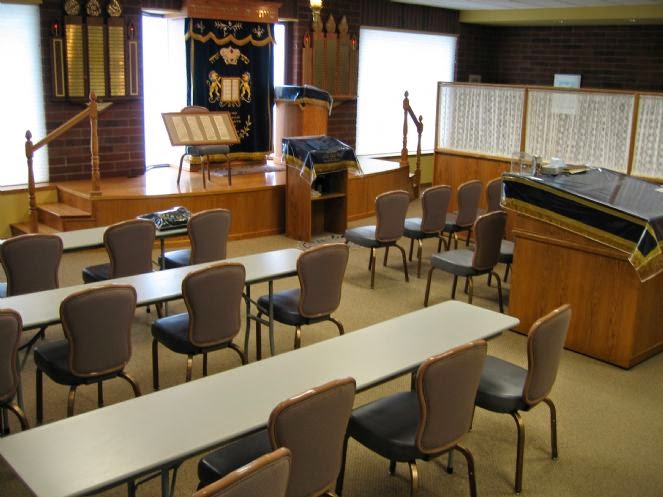
They forbid me to take notes or pictures. When I asked a member later, they told me it was due to the Sabbath restrictions. The synagogue is located in the district of Salt Lake known as Sugar House, strangely enough just a couple blocks down from the Scientology Church. The synagogue is located in a complex with several rooms for different functions, including a mikvah (roughly equivalent to a Christian baptismal font used for purification ceremonies) and a social hall. The synagogue itself was a smaller room. I found a picture of it online.


To explain this picture, the Orthodox tend to refer to the synagogue as "shul," meaning "school." As you can see from the setup, it is very much like a classroom, complete with desks. The front of the sanctuary has the ark, the chest covered by the tapestry which contains the Torah scrolls. In front of that is a small podium at the ground level where the prayers are recited, and towards the back is the bimah, the platform from which the Torah scrolls are read.

There was one part of the layout of the synagogue that really bothered me. I knew it was coming, I know about the tradition behind it, but it upset me. There is a partition that separates the men from the women called a mechitza. This is done for modesty reasons, but it was just so indicative of gender roles in this faith. You can see the partition in the photograph, and if you'll notice, everything of importance is on the men's side: the ark, the podium where they say prayers, the bimah, etc. and only men participate in the ceremonies. The women seemed to be literally pushed to the side almost as an afterthought. I understand this is a long standing tradition in Judaism and is part of their culture. But it was also part of our culture to keep women in the home and not to speak her mind. Some traditions have no place in the 21st century.

Overall, the atmosphere was traditional, but not as inspiring as the Reform synagogue.

The People:

The people were quite interesting. It was like something out of a movie or cliche, the men were dressed alike in the traditional garb you associate with Orthodox Jews, the black slacks, white dress shirts, black yarmulkes, the black, wide brimmed hats, beards, etc. In the synagogue, many of the men wore prayer shawls and swayed back and forth as they prayed.

I didn't really get a chance to talk with any of the women, only the men. They were all happy to have us there to observe them. I didn't feel like any of them were uncomfortable that we were there. A few asked if I had been to a synagogue before, when I explained I had, some seemed a little put off that it had been a Reform synagogue, others seemed happy and asked me a lot of questions saying some of their family or friends went to that synagogue.

Overall, I could tell that these people were very vested in their roots and traditions.

The Service:

The service was an endurance test. The members even acknowledged this afterwards with us. It was a 3 hour service all spoken in Hebrew and divided into 3 portions, morning prayers, Torah readings, and Haftarah (readings from other scriptures) with a sermon.

The first hour was nothing but a long prayer chanted by the rabbi with a few acapella songs in between. There was an English translation of the prayers in the book, but it was hard to follow along with as I never knew exactly where we were in the service.

The second hour had them bring the Torah scrolls around, and everyone touched either a book or their shawls to the scrolls then kissed the book or shawl. They then did 7 readings from the Torah scrolls.

After that there was a reading from Ezekiel and a sermon, which I will cover in "The Message" section.

There was no passion or emotion in the service like there was in the Reform service. The rabbi flew through the prayers, at times sounding like a cattle auctioneer. I got the strong feeling from them that they were doing this almost exclusively out of obligation and tradition, and not with any real meaning behind it.

Overall, the service was very long, I was lost much of the time, and quite monotonous and boring.

The Message:

The readings from the Torah were translated for me in the book into English. The verses were some of my least favorite in scripture. Verses talking about how if the daughter of a priest was found to have committed sexual sin, she should be burned alive and how those with physical defects are unworthy to be priests.

They somehow spun that into something positive. The rabbi stated in his sermon that the real message behind this is that even the worst of human traits can be used for positive things. He told a story about a family that was having issues with their son. He didn't go into many of the issues, but he said that the boy was in a treatment retreat and meeting with therapists. The boy told his parents that he wanted nothing to do with them if they didn't accept him as he was and he wasn't going to live the Orthodox life. His parents said he was out, but the Rabbi said that the family must absolutely accept their son because God gave him to them and human beings are imperfect paintings, but it is our imperfection that makes us beautiful.

As the service was ending, he read a poem about how we can learn virtues from even the thief. The thief is patient, the thief observes, the thief is thoughtful, but most of all, if the thief fails, he will try and try again.

The message was awesome, and I would love to see more messages like that from the pulpit in more religious communities.

Overall Experience:

This service was a learning experience, but it's not something I would do again. It was quite boring, the separation of the women bothered me a lot more than I expected, and it was just too strict and harsh. I loved the message, but there was a lot missing from it for me.

Additional Notes:

I am working on a few special projects which has been part of the reason the blog hasn't been as consistent. I will make a double effort to return to the normal schedule.

I am hoping you will be excited by some of the special blog entries coming up.

Until next time, peace be with you.

Monday, April 28, 2014

Scientology Redeux: Sermons, Books, and E-meters. Oh my!

Yesterday, I went to the Church of Scientology for their regular Sunday service. As stated in my earlier blog, I went back to actually see the Church in action, since my first time was basically just a Q&A session. I wasn't sure what the Sunday service would be like, and went into it almost blind. What did I experience?

Atmosphere:


The church is the same one I described in my previous Scientology blog, however, the chapel was new. The chapel was a room off to the side with a coffee pot, some chairs lined up into three or four rows, a wooden pulpit up in the front with a book on it, a television set up in the front, and a display in the back with a list of L. Ron Hubbard's books and various pamphlets.

The chapel was a very simple setup, no frills, the most visually stimulating thing in it was the large window in the front looking out onto the road which was filled with trees in bloom and people walking their dogs.

Overall, this chapel was simple and basically built for function and not for beauty.

The People:

There weren't many people in the congregation. Only about six regulars and then me, Austin, and a couple other visitors. The person running the service was a woman who was very nice and had a pretty interesting background. More on that in "The Message" section. The people, in general, just seemed like nice people and that they sincerely believed in this.

The Service:

The service was very short, over in less than 15 minutes. It started with them reading the Creed of the Church of Scientology, which I would display here, but I know their church copyrights all their materials and often does litigate often, so I'll just say, in general terms what the creed says:

  • All men are equal.
  • All men have inalienable rights to life, religious freedom, sanity, defense, choice, speech, and creativity.
  • Only God can take away these rights.
  • Mankind's nature is good.
  • Man tries to survive by himself and with his brothers.
  • Nobody has the right to harm or destroy others.
  • The spirit and body can be saved.
After they read the creed, the woman leading the service began reading a sermon from L. Ron Hubbard out of the book in the front. The sermon basically talked about how he had discovered the way to freedom, and it would be arrogant for him to say that it's the totality of truth, but it is a new and modern, workable truth. It then ended with them pitching a book written by L. Ron Hubbard that you could purchase to learn more about what he had said.

They then read a prayer for total freedom, which basically was a plea to God to end human suffering.

The service was then over, and the floor was opened up for a Q&A. Here is where we will transition to the message portion.

The Message:

The service didn't give much of a message, but the Q&A certainly did. Someone asked about the Church's image in the media. The lady said, basically, that the media distorts everything and that the Church isn't at all what the media paints it to be, and all it wants to do is destroy anything good and prosperous.

During that time, the lady mentioned that Scientology was an open religion, and that anyone from any faith could join, and this included atheists and agnostics. I then pointed out that the Creed and the prayer they had read from mention God explicitly, and how that can be the case. She said that it was an individual's own reality whether they accepted God or not. She said that she knew a few, but not many, Scientologists who came into the faith as atheists, but as you spend more time in the faith, you'll begin to see that there is a reality beyond us most call God. In other words, come in with what you want, but eventually, you'll assimilate to our beliefs.

She stated also that she had had problems with schizophrenia and other mental conditions and that Scientology had helped her overcome that. She then looked at me and asked, "Do I look crazy to you?" Which, I didn't think was a good question to ask a stranger. I told her that I've known people who are battling mental illness who look fine for long periods of time, but they're not. She didn't like that response and said that she was fine, no more hallucinations, no anxiety, nor depression.

Someone asked a question I can't remember, and the lady responded by talking about the Tone Scale as though it were something we were all familiar with. I asked what the tone scale was. She pulled out a book, and said basically that it was a scale that registers human emotions. She held it up and explained that people's emotions and behaviors fall somewhere on this scale within certain bands. I asked if I could see it, she quickly folded it up and put it back in the book and said, I'll see if we have any in the bookstore for you. A few minutes later, a lady returned with a book and a pamphlet with the tone chart in it. She told me I could buy the book for $25 or I could buy the pamphlet for $5. I was sort of shocked that they were pimping out the pamphlet to me for a price.

That was the thing I noticed most, everything costs money except the promotional materials they sent us away with. I grabbed a bunch of their pamphlets as I left, and all of them are brief blurbs about various books or courses and then have registration forms. The books range anywhere from 25 to 40 dollars for hardbacks. That's not terrible for book prices. But there are dozens of books all at that price and you're encouraged to buy as many of them as possible. And then there are the courses. If you want to know anything outside the basics of their religion, you must take these courses. There are dozens of courses and the price tags I see on some of them. I have about 15 pamphlets and the cost of the courses I took pamphlets on run from $110 to $875 per course.

Back to the Tone Scale, she did let me see the pamphlet and look it over, but I didn't purchase it. Essentially, it's this chart that classifies humans along a scale from 0.1 to 4.0. These are 9 categories of people and explains what each of these types of people acts like, how they react to certain situations, what their sexual behavior is like, and what they contribute to society. She stated that people can be different things on the tone scale at different times. I found the Tone Scale to be extremely limited. It's possible to feel multiple emotions at the same time, but the Tone Scale isn't set up that way. I asked and she said it's based on the long term feelings of a person. Again, I said that you can feel may of these things at the same time, and the more I looked at the scale, the more I realized that it divided the complexity of human emotion into 9 categories and tried to shove people into different boxes based on this.

After a few more questions, we got a demonstration of the e-meter, Scientology's tool used in auditing. Essentially, it's a machine hooked up to a couple of tin cans that are held in the hand. The machine has some dials and a needle that moves up and down. After a thorough demonstration of the e-meter, I determined it's not an effective tool at all. There was no consistency with how the needle moved, I tested it in a couple ways, and nothing happened. When my friend was using the machine, his needle moved entirely differently from mine, and they said, that's what we want to see. And with mine, they said the same thing. There doesn't seem any rhyme or reason to the e-meter, it seems like it's more a tool for cold reading.

Overall Experience:

This seemed to be nothing more than a money making scheme masquerading as a religion. The intro materials are universal beliefs that they promote, and they really promote it as a self journey. It's all about you. You can believe what you want. You can get in touch with yourself. They also promise the Moon: we can get you off of drugs, you can be a better communicator, we can raise your IQ, we can give you a better marriage, we can cure your mental illnesses, etc. But it all comes at a huge price tag.

If they truly believed they had the truth and were genuinely interested in saving the world with their techniques, why wouldn't they offer it to people for free or only the cost of materials? Other churches will give you materials for free, they will tell you all you need to know free of charge, they may have a study group with a marginal fee, usually they'll waive it if you can't pay it, but generally, churches never charge money to teach their parishioners. But everything in this church costs money.

A friendly warning for anyone who reads this who is seeking a spiritual home, avoid any group that makes promises that seem too good to be true, avoid easy answers to complicated question. If a group has you sign papers of non-disclosure, asks you to invest huge amounts of money, or asks for money up front, run! All of these are red flags for a group seeking to exploit you.

Additional Comments:

I will be making a video soon about the past few weeks. Until next time, peace be with you.

Saturday, April 26, 2014

Scientology: Part Deux

Because we didn't go for an actual service, we have decided to hit up the Scientologists for this week's Sunday service. I'm wondering what the service is going to be like, as I haven't found much online about it. I read something about group auditing. I'm not sure how that works, but I'm not sharing personal things if they expect me to. I am simply there to observe.

This is the closest I have done to going into a service blind. I really don't have much else to say.

Until next time, peace be with you.

SCIENTOLOGY

That's right, surprise to all of you! I went to the Church of Scientology in Salt Lake City. I did it for a couple reasons, I felt that I owed you guys after not going to Good Friday services, and that I really needed to do something many know about, but not fully.

This blog will be a little different as I'm combining both the pre-service and regular blog in one. Also, structure is going to be pretty free form with this one.

Quick facts about the Church of Scientology:

  • The Church was started in twentieth century by science fiction writer, L. Ron Hubbard.
  • The Church was first started from a self-help book Hubbard wrote called Dianetics which was his response to modern psychology.
  • The exact number of members is unknown, as the Church does not disclose that information. Estimates range from 50,000 to 10,000,000
  • The name is derived from a mixture of Latin and Greek words, "science" meaning "knowlege" and "logos" which as a suffix means "study of." Therefore the study of knowledge, but not in the same sense as epistemology, which is a philosophical study of knowledge.
  • Scientology has an official clergy named Sea Org, and is modeled after a navy because of L. Ron Hubbard's naval background.
  • The Church is currently run by David Miscavige.
  • The Church uses a service called auditing in which members hold onto a machine called an e-meter, which they believe helps them purge themselves of impurities in their life that are holding them back.
  • You can progress through various levels of the Church through courses and auditing until you become what is called Clear. Once you become Clear, you are free to start taking advanced courses called Operating Thetan courses or OT. Several of these courses contain sensitive and controversial materials that most Scientologists do not know about, including stories about aliens and alien spirits. Upper level Scientologists are told not to talk about and deny these stories, and lower level members have never heard of it. These stories are reported by virtually all upper level Scientologists who have left.
  • Scientology actively courts celebrities, and has a special center for them in California. Several famous Scientologist celebrities include: Tom Cruise, John Travolta, Kirstie Alley, Jason Lee, Jenna Elfman, Greta Van Susteren, Anne Archer, Elizabeth Moss, Giovanni Ribisi, Beck, etc.
  • The Church teaches mankind is made up of three parts, similar to Christian belief, of mind, body, and spirit. They refer to the spirit as a thetan and it is what you truly are, not something you have.
  • Scientologists oppose psychology and traditional psychotherapy.
The experience was interesting. We started by going down to Salt Lake where there are two Scientology buildings, one downtown, and one in the district of the city called Sugar House, which is sort of a hippie/hipster part of town. We went to the mission which is downtown, but it was closed. I did snap a few pictures of it.


This is outside of the mission. It's in the basement of an office suite.


This is the guest book just outside of the mission. We were sad it was closed. The mission appears to be one room with a table, two chairs, a fridge, treadmills, and a few posters.

So, we drove down to the main church which, fortunately was open. In the parking lot of the building was a van for their volunteer ministry.


There was also a sign that was over the back door that talked about increasing your IQ, which I found to be quite interesting.

We entered the main lobby doors and it was a modern, loft style suite. There was an advertisement near the stairs going upstairs for a class of some kind. On the level just below the entrance was a desk with a man sitting in it. He came and introduced himself, asking what we were doing there. After explaining that we were curious, he asked us if we wanted to do orientation. We agreed and he took us to it.

Orientation was in a small room, no more than 10 foot square and a low ceiling. The room had a big screen television, 3 chairs, a bookshelf, several posters on the wall, and a nightstand with a lamp on it. They turned on the movie and left the room shutting the door behind them. I had the distinct feeling we were being filmed the entire time. I have no proof of it, but I definitely felt like they were monitoring us. Lisa and Austin who were with me agreed with that assessment.

The video featured an introduction to the religion, including a long promotion of L. Ron Hubbard that glorified him considerably, it also talked about the structure of the Church quite extensively. I could see why it appeals to many people, they promote yourself and constantly state that the religion is about you. They tell the members that they are free to bring in their old beliefs, so they can be Catholic, Baptist, Muslim, atheist, etc, and be a Scientologist. I found it interesting that they said you could be an atheist, but much of their literature explicitly refers to God. One thing in the video that sort of bothered me was that they said that the Church has it's own law that's not the law of the land, so if you have an issue in the church, go through the church's law.

After the video ended, a young woman came into the room and set a chair down in front of us for a Q&A. We asked a few questions about the structure of the church, and they told us about books we could buy or rent from their bookstore. More on that in a bit.

We then had to get going, because Austin had to work. They sent us away with a stack of literature and DVD's. I watched the DVD's with Lisa and Austin. They essentially teach the most basic of concepts of the Church, then tell you after each segment to go buy a book or sign up for a course. There is a course list. I noticed that nothing in the Church is free other than the personality test they send you away with. Everything comes with a price, whether buying or renting. I don't know how much these courses cost, but I imagine they're not cheap, and I know even auditing has a price tag on it.

After watching the videos, I have to say, there isn't much in the way of doctrine or belief that I could see. It seemed like a bunch of self help books tied to a Church and all with a price tag. This is a red flag to me. You shouldn't have to pay all of this money for spiritual counseling and self help courses, and it bothers me they have different levels you have to pay your way to through courses.

I have to say that Scientology was both slightly unnerving when they locked us in a room to watch a movie, seemed appealing and benign from the videos, and also seemed to have a very sweet side, but also quite a sinister side to it as well.

I may be going back to one of their Sunday services sometime, and might blog about it just to have a full assessment of them.

I will be doing a video on this visit which includes some of the literature I was sent home with. 

Until next time, peace be with you.

Friday, April 25, 2014

Easter at the Atheist National Convention

I want to apologize for the absence and delay in getting these up. It's been quite a long week, and I fell behind. I spent Easter Sunday at the American Atheist National Convention. What was my time like at the convention?

Atmosphere:

The event was held in the Hilton Hotel in Salt Lake City. The Hilton is, as expected, sleek, modern, and well decorated. It was held on the second floor of the hotel which featured several ball rooms/convention rooms that were used. They even included free coffee and drinks at various parts of the day, in your choice of paper or ceramic or glass cups.

Overall, gorgeous atmosphere all easily accessible.

The People:

There was a wide variety of people there. People of many races, sexual orientations, fashion trends, social groups, etc. Really, the only thing that united everyone was the atheist aspect. Even there, people were across a spectrum of how that affected their lives.

I met some really cool people I had enjoyed seeing on YouTube or in podcasts. There were a number of people who's brains I wanted to pick, including a podcaster I have been following for a couple years now. More on him later.

I made a few friends there, and had a wonderful time with the people. I hope to keep in touch with a few.

The Exhibits:

There were some really great exhibits. There were several art booths that featured hand crafted art of portraits from famous scientists to galaxies and plants. A few of the exhibits were devoted to a particular cause, like student associations, political action groups, etc. I really enjoyed a fair trade foods booth that had some really good chocolate and apricots that they were handing out as samples.

But my favorite booth of all of them was one that had very sarcastic merchandise. This booth had bumper stickers, decals, pins, DNA ties, etc. My favorite thing on that booth was something called Nunzilla. It's a windup toy that is a vicious looking nun, and when she's in use, sparks shoot out of her mouth. I need this in my life.

In addition to the room that had the exhibits, there was a separate room which had books. One side was a normal sort of traveling bookstore with books on religion, science, politics, etc. The second half of the room was a grab bag room. You purchased a little bag, and whatever you could fit into the bag, you could have. My friend Austin took full advantage of that and loaded the bag until it looked like it was going to burst.

The exhibits were fun, and I got some cards out of it so I can buy some nice merchandise pretty soon.

The Speakers:

This was sort of the core of the convention. There were constantly speakers talking on various things with only 10 to 15 minute breaks between them. The talks were held in the main convention room, which was really lovely and modern.


The first speakers I saw was a panel on LGBT issues in the atheist community. I have to admit, I was half asleep during this lecture due to it being really early in the morning after not sleeping long after a very long week. That being said, this was probably my least favorite talk during the convention. Sad, because I am a gay man. One man complained that there wasn't more gay representation at the convention, another woman stated that she wanted to see a total end to religion, a sentiment I do not and cannot share.

Two of the talks that really stuck out to me were the ones on how to come out as an atheist and one on the LDS Church.

The talk on coming out as an atheist was given by a woman who had her family unintentionally discover she was an atheist from pictures on Google. She had both positive and negative reactions from some family members, and it has strained her relationship with several of them permanently. She offered a lot of really good advice that was similar to how many come out as gay.

The other talk on the LDS Church was interesting to me, being an ex-Mormon. The man had to rush through his speech because of time constraints (They weren't very well organized with the speakers and a few were cut short). It's sad, because he had a lot of really good material I wanted to see, and felt a lot of people needed to see there.

The last speech I saw was by a podcaster I enjoy following. His speech was on Christian hijacking and rebranding of pop culture over the past 30 to 40 years. Everything from Christians stealing the image of pop and rock musicians and creating their own versions of these pop stars, to blatantly ripping off logos, movies, or other pop culture items and intentionally rebranding them as Christian. It was a very interesting topic and made me realize just how commercial a lot of modern Christianity has become. I will be doing a bit more research on that and maybe do a vlog on it sometime soon.

Overall Experience:

This was a very great day. I couldn't imagine a better way to have spent Easter Sunday than discussing religion with people who normally don't get heard in the religious dialogue except as people to be feared or mocked. You will find in life that atheists are just normal people who happen not to believe in God, and there are good and bad ones just like all other groups of people. I don't understand the why atheists are demonized so much, but it's an unfair thing as many know as much or more about religion than religious people and deserve to be heard.

I am now in the process of writing my very special blog. Monday, I went to the Church of Scientology. Stay tuned, that blog will be up very soon.

Until then, peace be with you!

Sunday, April 20, 2014

Final stop on the Holy Week journey: Easter Sunday at...

The American Atheist National Convention. That's right, this year's National Convention is being held in Salt Lake City, Utah, and yours truly will be spending their Easter Sunday there. Bet you weren't expecting that, were you?

The convention will consist primarily of speakers and exhibits. I am quite excited to take part in this. While there are some aspects of modern atheism that do annoy me, I am technically an atheist, one who happens to be quite interested in the subject of religion and does take it seriously, but I'm also somebody who takes a learned and critical approach to the subject of religion.

This is a national convention, so I'm expecting to see some interesting things. I will, as usual, let you know my honest opinion about the event and will not hold back any thoughts on the matter.

Because this will not be a typical religious service, my blog entry for this service will be different than the usual format. I will be following the following format:

  • "Atmosphere" section will be replaced with "Venue Setup and Accessibility."
  • "The People" will remain as I will be meeting a number of people there.
  • "The Service" section will be replaced with "The Exhibits."
  • "The Message" section will be replaced with "The Speakers." This section will be broken down by individual speakers.
  • And, obviously, "Overall Experience" will remain the same.
Can't wait to report on this one. Until next time, peace be with you.
Wednesday, March 12, 2014

שְׁמַע יִשְׂרָאֵל יהוה אֱלֹהֵינוּ יהוה אֶחָד Sh'ma Yisrael ADONAI Eloheinu, ADONAI Echad! Hear, O, Israel, the LORD our God, the LORD is One!

*** UPDATE ***
Due to some personal problems, my friend whom I was going to go with is no longer able to go. I will therefore not be going to Kol Ami Synagogue in Salt Lake, but will be attending the synagogue here in Ogden, Congregation Brith Sholem. This congregation is similar to Kol Ami in that they take from both the Conservative and Reform Traditions of Judaism. It differs in that it seems to be a smaller more humble congregation that doesn't have a permanent Rabbi and is instead run entirely by the laity of the congregation. I'm very curious to see this and will update you if there are any further developments.


Those are the most famous words in all of Judaism. They are central to the faith and said at each service. I figured there would be no better way to introduce my journey to Kol Ami Synagogue this Friday evening than to echo those words.

Congregation Kol Ami is located in Salt Lake City. It is one of the most popular synagogues in the state (of course I'm only aware of four of them). The congregation is an interesting one as it borrows from both Conservative and Reform traditions.

I am painfully aware that there is a great deal of ignorance when it comes to the Jewish faith. A lot of people in the United States don't know much about it. Therefore, I will fill in some gaps. Let's start by going over a couple things that Judaism isn't.
  1. Judaism is not Christianity. Jews do not worship, follow, nor in any way view Jesus as a central character to their religion. Period. I know this should be obvious. But it amazes me how many people I've talked to who don't know that. There is a very small group of Jews called Messianic Jews who are basically Jewish Christians. But they're a small minority and not at all representative of Judaism as a whole.
  2. Judaism is NOT just the prequel to Christianity. Christianity came out of Judaism and uses the Jewish scriptures, what the Christians call the Old Testament in their scriptures. However, Judaism does not need Christianity at all to survive, and is its own religion with over 4,000 years of rich culture and history behind it. To fail to see it is to miss out on Judaism entirely. Judaism didn't stop at Jesus, it continued on for another 2,000 years after him.
With that out of the way, let's talk about Judaism.
  • Judaism started roughly 4,000 years ago, some would argue earlier, as a tribal religion in what is called the Holy Land. Some of the seminal figures in the Jewish scriptures are: Abraham, the first monotheist, according to tradition, and the Father of the Faith; Moses, who, according to tradition, led the Jews out of enslavement in Egypt and received the Torah from God; King David, the first great King of a unified Israel; Solomon, the Wisest King; and various prophets, including Daniel; Isaiah; Elijah; and Jeremiah.
  • During biblical times, the central focus of Jewish worship was the Temple in Jerusalem. Animal sacrifice and daily prayers by priests were the central forms of worship. The Temple was destroyed for a second and final time in 70 CE (AD) by the Romans and has been in ruins ever since. Since then, Jewish worship has been centered around the synagogue, which are houses of worship and learning.
  • Jews are strict monotheists worshiping one unified God who is seen as the ruler of all the Universe and beside whom there is no other god.
  • Judaism has a number of holidays, the most well known are: Rosh Hashana, the Jewish New year; Yom Kippur, the Day of Attonement; Hanukkah, the Festival of Lights; and Pesach, or Passover.
  • There are three major sects of Judaism and a number of smaller ones: Orthodox Judaism, which is staunch in its interpretation of Jewish Law and extremely traditional; Reform Judaism, which is very liberal and seeks a Judaism that redefines itself to be relevant in the modern era; and Conservative Judaism which lies between the two.
  • The central scripture in Judaism is the Bible, or what Christians call the Old Testament. But the most important part are the first five books called the Torah: Genesis, Exodus, Leviticus, Numbers, Deuteronomy, said to be God's word to mankind.
  • The Jewish Sabbath is not on Sunday like the Christian one, but is on Saturday and begins Friday night at sunset, hence why I am going to services Friday evening.
  • Concepts of the afterlife are not concrete in Judaism. Some Jews believe in an afterlife, some do not. Similarly, some Jews anticipate a messiah and the resurrection of the dead, and some Jews do not.
As I said before, the congregation I am going to takes from both Conservative and Reform traditions, which I think will be an interesting blend to see. I'm quite excited as I have never been to a synagogue and would love to experience it the rich heritage Judaism has expressed for a modern era. I am going with a friend who is a congregant there, so hopefully I'm not too much a fish out of water.

I will let you know how everything goes.

Until then, peace be with you.