Showing posts with label Judaism. Show all posts

Monday, May 5, 2014

Went old school. My time with the Orthodox Jews.

Sorry about the spotty nature of my blog output recently. Been a busy couple of weeks, I apologize. This week, my blog will be returning to normal.

This week I went to an Orthodox Jewish synagogue. A little background on Orthodox Judaism:

  • Jewish Law has 613 commandments that Orthodox Jews feel must be observed.
  • Orthodox Judaism observes a very strict interpretation of these laws which include: prohibitions against many acts on the Sabbath, such as no work, no writing, no cooking, etc.; strict gender roles; observance of Kosher; etc.
  • Use of Hebrew only in worship.
  • Traditional worship passed down through the ages.
  • Following the teachings of rabbis and rebbes. Rebbes are higher than rabbis and are similar in ways to gurus in Hinduism.
  • For more information on Judaism in general, see my blog on Reform Judaism.
So how was the experience?

Atmosphere:

They forbid me to take notes or pictures. When I asked a member later, they told me it was due to the Sabbath restrictions. The synagogue is located in the district of Salt Lake known as Sugar House, strangely enough just a couple blocks down from the Scientology Church. The synagogue is located in a complex with several rooms for different functions, including a mikvah (roughly equivalent to a Christian baptismal font used for purification ceremonies) and a social hall. The synagogue itself was a smaller room. I found a picture of it online.
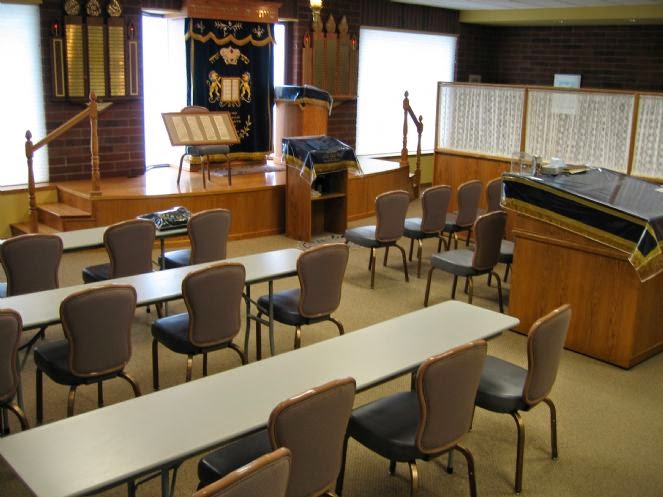

To explain this picture, the Orthodox tend to refer to the synagogue as "shul," meaning "school." As you can see from the setup, it is very much like a classroom, complete with desks. The front of the sanctuary has the ark, the chest covered by the tapestry which contains the Torah scrolls. In front of that is a small podium at the ground level where the prayers are recited, and towards the back is the bimah, the platform from which the Torah scrolls are read.

There was one part of the layout of the synagogue that really bothered me. I knew it was coming, I know about the tradition behind it, but it upset me. There is a partition that separates the men from the women called a mechitza. This is done for modesty reasons, but it was just so indicative of gender roles in this faith. You can see the partition in the photograph, and if you'll notice, everything of importance is on the men's side: the ark, the podium where they say prayers, the bimah, etc. and only men participate in the ceremonies. The women seemed to be literally pushed to the side almost as an afterthought. I understand this is a long standing tradition in Judaism and is part of their culture. But it was also part of our culture to keep women in the home and not to speak her mind. Some traditions have no place in the 21st century.

Overall, the atmosphere was traditional, but not as inspiring as the Reform synagogue.

The People:

The people were quite interesting. It was like something out of a movie or cliche, the men were dressed alike in the traditional garb you associate with Orthodox Jews, the black slacks, white dress shirts, black yarmulkes, the black, wide brimmed hats, beards, etc. In the synagogue, many of the men wore prayer shawls and swayed back and forth as they prayed.

I didn't really get a chance to talk with any of the women, only the men. They were all happy to have us there to observe them. I didn't feel like any of them were uncomfortable that we were there. A few asked if I had been to a synagogue before, when I explained I had, some seemed a little put off that it had been a Reform synagogue, others seemed happy and asked me a lot of questions saying some of their family or friends went to that synagogue.

Overall, I could tell that these people were very vested in their roots and traditions.

The Service:

The service was an endurance test. The members even acknowledged this afterwards with us. It was a 3 hour service all spoken in Hebrew and divided into 3 portions, morning prayers, Torah readings, and Haftarah (readings from other scriptures) with a sermon.

The first hour was nothing but a long prayer chanted by the rabbi with a few acapella songs in between. There was an English translation of the prayers in the book, but it was hard to follow along with as I never knew exactly where we were in the service.

The second hour had them bring the Torah scrolls around, and everyone touched either a book or their shawls to the scrolls then kissed the book or shawl. They then did 7 readings from the Torah scrolls.

After that there was a reading from Ezekiel and a sermon, which I will cover in "The Message" section.

There was no passion or emotion in the service like there was in the Reform service. The rabbi flew through the prayers, at times sounding like a cattle auctioneer. I got the strong feeling from them that they were doing this almost exclusively out of obligation and tradition, and not with any real meaning behind it.

Overall, the service was very long, I was lost much of the time, and quite monotonous and boring.

The Message:

The readings from the Torah were translated for me in the book into English. The verses were some of my least favorite in scripture. Verses talking about how if the daughter of a priest was found to have committed sexual sin, she should be burned alive and how those with physical defects are unworthy to be priests.

They somehow spun that into something positive. The rabbi stated in his sermon that the real message behind this is that even the worst of human traits can be used for positive things. He told a story about a family that was having issues with their son. He didn't go into many of the issues, but he said that the boy was in a treatment retreat and meeting with therapists. The boy told his parents that he wanted nothing to do with them if they didn't accept him as he was and he wasn't going to live the Orthodox life. His parents said he was out, but the Rabbi said that the family must absolutely accept their son because God gave him to them and human beings are imperfect paintings, but it is our imperfection that makes us beautiful.

As the service was ending, he read a poem about how we can learn virtues from even the thief. The thief is patient, the thief observes, the thief is thoughtful, but most of all, if the thief fails, he will try and try again.

The message was awesome, and I would love to see more messages like that from the pulpit in more religious communities.

Overall Experience:

This service was a learning experience, but it's not something I would do again. It was quite boring, the separation of the women bothered me a lot more than I expected, and it was just too strict and harsh. I loved the message, but there was a lot missing from it for me.

Additional Notes:

I am working on a few special projects which has been part of the reason the blog hasn't been as consistent. I will make a double effort to return to the normal schedule.

I am hoping you will be excited by some of the special blog entries coming up.

Until next time, peace be with you.

Sunday, March 16, 2014

Blessed are you, Adonai, Sovereign of the Universe...

Yesterday, I went to Congregation Brith Sholem, a synagogue here in Ogden. If you didn't have a chance to read the update on the pre-service blog for this, my friend who is a congregant at Kol Ami was unable to make it due to personal issues. So, I chose the synagogue closer to home. What was my first time in a synagogue like?

Atmosphere:

Brith Sholem is not located in a good part of town. I assume that it was built back when this area was nice, but as it is today, it's not prime real estate. When you first pull up to it, it's a modest brick building with white columns on the facade of the building.


But, when you enter the doors of the synagogue, you are no longer in downtown Ogden, but transported to a sanctuary of peace and simple beauty. The walls are all white, and there is a simple area when you first walk in that's used for practical purposes like social functions, keeping kippot (yarmulkes), prayer shawls, prayer books, etc.

The main sanctuary is separated from this area through a doorway. The main sanctuary is also white with red chairs lined up facing the front.


At the front of the sanctuary is a raised platform separated by a rail. Upon this platform is a piano to the right side with a menorah, the Shabbat (Sabbath) candlesticks, and flower arrangements.


Of course the most important part of the sanctuary are the bimah, a large table decorated with fine cloths used for reading the Torah, and behind the bimah is the arc, a cabinet which contains the Torah scrolls. This is the most sacred space in a synagogue and represents God's presence on Earth through the Word.


Along the walls of the sanctuary are five modern, stained glass windows. One is a window which represents the menorah and the Torah.


The other four windows represent the four seasons. This first one  represents Spring and was my favorite.


The atmosphere at Brith Sholem was very lovely and I found it to be a very pleasant gem in Ogden.

The People:

The people were extremely welcoming and kind to us. I was accompanied by two of my oldest and dearest friends, Lisa and Heather. None of us are Jewish and this was the first time any of us had ever been in a synagogue. As soon as we walked in, a nice gentleman asked us who we were, where we were from, and showed us the prayer books and explained a bit about the service. Most members of the congregation came and introduced themselves to us. The one that suck out the most to me was the president of the congregation. She seemed like a lovey and kind hearted woman. After the service she came over and talked to us about about some of the traditions of Judaism and was very kind in welcoming us back later.

The service was truly a community effort with people from the congregation of all ages participating in the service in one role or another. I really enjoyed this as it made it feel like everyone was potentially as important as the other.

The community seems very close knit and full of joy. I felt very at home and at peace there.

The Service:

The service was breathtaking. The service was lead by the student rabbi, a young woman who is going to be a great rabbi since she's already a very good student rabbi, who is doing her internship at this congregation and visits once a month.

I very much enjoyed the Hebrew hymns. It was so beautiful to hear the Psalms in their original language, and, though I don't understand Hebrew, I could tell just from how these hymns were sung that they were saturated with meaning. I actually didn't like when they started singing the hymns in English, as I felt it lost something in the process of translation.

There were a number of hymns and prayers that were said, I couldn't understand most of it because it was in Hebrew, but I did read the translations below the text a lot of the time. If you asked to now to remember a lot of what was said though, I wouldn't be able to tell you. I want to go back and learn more about this service.

The service then moved to the Torah reading. They opened the arc and brought the Torah scrolls around the congregation. Everyone either touched their books or prayer shawls to the Torah before kissing the book or prayer shall. They then read from the Torah in Hebrew. There was a melody that went along with reading each sentence that made the reading very moving.

Afterward, the student rabbi delivered a sermon. More on that in the message section.

Afterward, there were a series of prayers for various things. First was a prayer for those in the community who were sick. They mentioned a few names of those suffering with an affliction. Then the rabbi asked to congregation to name any names of people needing prayers for healing as she met their eyes. She then looked each member of the congregation in the eye and heard the names of various people afflicted with illness. A prayer was then said for healing for them.

Next were prayers for the community and nation, followed by a prayer for the State of Israel, which mostly focused on peace.

After this was a memorial prayer for those who had died. As done previously, the rabbi mentioned several names of members who had passed that they were remembering in particular, then asked the congregation to name anyone they wanted to remember. There was then a prayer for the memorial of the dead. This was, for some reason, my favorite part of the service.

After the service, there was a light potluck that I wished I could have stayed for longer, but I had things that I needed to do.

The Message:

The sermon the rabbi gave was one I related to very well. She mentioned how the reading was about Moses investing Aaron as the High Priest. As the text is sung out loud, there is a special melody used at the moment Moses is about to anoint Aaron. This melody is only sung a few other places when reading from the Torah and always indicates a moment of hesitation. Moses hesitates at this moment because in this moment, if Aaron is invested as the High Priest, Moses shall never be the High Priest and must accept another role and find his place in the community.

The rabbi then related a personal story of how when she was a teacher, she had grown fond of a student, and how hard it was to face and tell this student that she was leaving him and her profession behind to become a rabbi. She mentioned that the transition scared her, and that often our biggest changes in life come with a lot of hesitation and anxiety. But these feelings often indicate that we are moving into a path that will change us drastically, but is where we need to go. Being that my personal life is making a bunch of huge shifts very soon I related to this sermon. I think this is a message we all relate to at one point or another.

I knew before this that Jews had a complex way of looking at their scriptures, but until yesterday, I had no idea just how multi-layered it was. These melodies that accompany the readings are codified ways of adding more depth and meaning to the text. In Judaism, it seems, the words on the page and the stories within are not the end of the reading. To only see that would be the same as only seeing your face on the glass of a window and not the world outside. I feel this is something Christians need to learn from their Jewish brothers and sisters. I feel in the modern world, Christians often take a very surface level meaning of their religion and holy text. I feel there is much that could enrich them from their parent religion, Judaism.

Overall Experience:

This service was an amazing and eye-opening experience. I very much enjoyed this and would love to go back and learn more about the Jewish faith and traditions.

Additional Notes:

I did attend the Oneness Pentecostal church I mentioned in my previous pre-service blog. You can expect that blog to be up tomorrow, so keep an eye out for that.

I haven't selected a denomination for next week yet, but hopefully will have that selected by tomorrow in time for the blog post.

Until then, peace be with you.

Wednesday, March 12, 2014

שְׁמַע יִשְׂרָאֵל יהוה אֱלֹהֵינוּ יהוה אֶחָד Sh'ma Yisrael ADONAI Eloheinu, ADONAI Echad! Hear, O, Israel, the LORD our God, the LORD is One!

*** UPDATE ***
Due to some personal problems, my friend whom I was going to go with is no longer able to go. I will therefore not be going to Kol Ami Synagogue in Salt Lake, but will be attending the synagogue here in Ogden, Congregation Brith Sholem. This congregation is similar to Kol Ami in that they take from both the Conservative and Reform Traditions of Judaism. It differs in that it seems to be a smaller more humble congregation that doesn't have a permanent Rabbi and is instead run entirely by the laity of the congregation. I'm very curious to see this and will update you if there are any further developments.


Those are the most famous words in all of Judaism. They are central to the faith and said at each service. I figured there would be no better way to introduce my journey to Kol Ami Synagogue this Friday evening than to echo those words.

Congregation Kol Ami is located in Salt Lake City. It is one of the most popular synagogues in the state (of course I'm only aware of four of them). The congregation is an interesting one as it borrows from both Conservative and Reform traditions.

I am painfully aware that there is a great deal of ignorance when it comes to the Jewish faith. A lot of people in the United States don't know much about it. Therefore, I will fill in some gaps. Let's start by going over a couple things that Judaism isn't.
  1. Judaism is not Christianity. Jews do not worship, follow, nor in any way view Jesus as a central character to their religion. Period. I know this should be obvious. But it amazes me how many people I've talked to who don't know that. There is a very small group of Jews called Messianic Jews who are basically Jewish Christians. But they're a small minority and not at all representative of Judaism as a whole.
  2. Judaism is NOT just the prequel to Christianity. Christianity came out of Judaism and uses the Jewish scriptures, what the Christians call the Old Testament in their scriptures. However, Judaism does not need Christianity at all to survive, and is its own religion with over 4,000 years of rich culture and history behind it. To fail to see it is to miss out on Judaism entirely. Judaism didn't stop at Jesus, it continued on for another 2,000 years after him.
With that out of the way, let's talk about Judaism.
  • Judaism started roughly 4,000 years ago, some would argue earlier, as a tribal religion in what is called the Holy Land. Some of the seminal figures in the Jewish scriptures are: Abraham, the first monotheist, according to tradition, and the Father of the Faith; Moses, who, according to tradition, led the Jews out of enslavement in Egypt and received the Torah from God; King David, the first great King of a unified Israel; Solomon, the Wisest King; and various prophets, including Daniel; Isaiah; Elijah; and Jeremiah.
  • During biblical times, the central focus of Jewish worship was the Temple in Jerusalem. Animal sacrifice and daily prayers by priests were the central forms of worship. The Temple was destroyed for a second and final time in 70 CE (AD) by the Romans and has been in ruins ever since. Since then, Jewish worship has been centered around the synagogue, which are houses of worship and learning.
  • Jews are strict monotheists worshiping one unified God who is seen as the ruler of all the Universe and beside whom there is no other god.
  • Judaism has a number of holidays, the most well known are: Rosh Hashana, the Jewish New year; Yom Kippur, the Day of Attonement; Hanukkah, the Festival of Lights; and Pesach, or Passover.
  • There are three major sects of Judaism and a number of smaller ones: Orthodox Judaism, which is staunch in its interpretation of Jewish Law and extremely traditional; Reform Judaism, which is very liberal and seeks a Judaism that redefines itself to be relevant in the modern era; and Conservative Judaism which lies between the two.
  • The central scripture in Judaism is the Bible, or what Christians call the Old Testament. But the most important part are the first five books called the Torah: Genesis, Exodus, Leviticus, Numbers, Deuteronomy, said to be God's word to mankind.
  • The Jewish Sabbath is not on Sunday like the Christian one, but is on Saturday and begins Friday night at sunset, hence why I am going to services Friday evening.
  • Concepts of the afterlife are not concrete in Judaism. Some Jews believe in an afterlife, some do not. Similarly, some Jews anticipate a messiah and the resurrection of the dead, and some Jews do not.
As I said before, the congregation I am going to takes from both Conservative and Reform traditions, which I think will be an interesting blend to see. I'm quite excited as I have never been to a synagogue and would love to experience it the rich heritage Judaism has expressed for a modern era. I am going with a friend who is a congregant there, so hopefully I'm not too much a fish out of water.

I will let you know how everything goes.

Until then, peace be with you.