Showing posts with label Church of Jesus Christ of Latter-day Saints. Show all posts

Tuesday, September 2, 2014

A walk through a Mormon temple.

This past month, I went to the Ogden LDS Temple open house twice. The temple tours were identical minus the lines to get in (it was much more crowded the second time). The first time I attended with my friend, the second time with members of my immediate and extended family. Temples are normally not open to the public. In the weeks prior to them dedicating the temples, they allow the general public to tour them as they're not set aside for temple worship yet.

Because of the nature of this special blog, I will not follow the normal format. Instead, I will talk first about the general purposes and beliefs about the temples in the LDS Church; the video which begins the tour; the exterior of the building; and I will then describe the various rooms as I remember them, their purposes, and my impressions of them.

What Temples Mean to Mormons:

Temples are the most important places on earth to members of The Church of Jesus Christ of Latter-day Saints. For them, they are houses of the Lord. Many members of the LDS Church believe that God himself personally visits temples, and that the Holy Ghost's presence dwells within them.

Temples are unlike regular church buildings, which are called meeting houses in the Mormon tradition. Meeting houses are where regular Sunday worship occurs. All people are welcome to attend services at meeting houses. Regular services at meeting houses include: Sunday school for adults and children, various meetings for men and women, and a communion service called Sacrament meeting. I attended one of these services previously. Check out that blog here:

http://52weeks52churches.blogspot.com/2014/03/the-saints-testify.html

Temples on the other hand are open only to members of the LDS Church who meet strict requirements. These include:

  • A testimony that the teachings of the Church are true concerning God, Jesus, the atonement, that Joseph Smith restored the ancient Church that Christ started, and that the Church is the One True Church on earth with living prophets.
  • Complete sexual purity. This means the person has not had premarital sex, an extramarital affair, viewed pornographic or obscene material, engaged in any homosexual behavior whatsoever, or masturbated. If they have, they must have confessed the matter to a bishop of the church (similar to a pastor in most churches) and gone through a probation period (often a year) before they may enter the temple. In all honesty, I have known a shockingly high percentage of people in the Church who lie about this one during interviews. There is a large stigma surrounding sexual sin in the Church. It is called the sin next to murder and as such, many lie about it. This isn't unique to Mormons, but a common thread among conservative churches which demonize all sex outside of marriage.
  • Ensuring your relationship with your family is in accordance with Church teachings. Essentially that you're not abusing your family, that you are fulfilling your responsibilities, etc.
  • Ensuring that you do not support nor associate with any person or group who's beliefs and practices aren't in harmony with the teachings of the Church.
  • That you attend your regular church meetings and try to keep your covenants to the best of your ability.
  • Being honest in your dealings with people.
  • That you pay a full and honest tithe. This for members of the Church is 10% of all of your gross income. Though some interpret it to mean net income.
If members do not meet 100% of these requirements, they are not permitted to participate in temple ceremonies nor even enter the temple.

Temples ceremonies are quite different than ceremonies in meeting houses. They are composed of rituals for the living and the dead and follow strict formatting, special clothing, and secrets only temple worthy members are told. All things that happen within the temple are not to be discussed with outsiders. Members say that these ceremonies aren't secret, they're sacred and shouldn't be talked about. This statement has never made sense to me as they are secret ceremonies because they are sacred to them. Therefore they are sacred AND secret to members.

The Video Prior to the Tour:

Just before the tour, there is a short video about what temples mean to the Church. They don't really go into much detail as to what truly happens inside a temple nor their true significance. This is a common theme in the temple tour. There are no tour guides, they rush you through the temple, they don't encourage questions while on the tour (nor is it really easy to ask questions of the temple workers), and they tell you there is a tent outside which will give you more information about the various rooms, but it mostly tells you about the building structure and materials than anything else.

The video features several members of the Quorum of the Twelve Apostles. This group of twelve men, along with the President of the Church and his two counselors (known as the First Presidency) make up the most senior leadership of the Church. Some spoke about temples being important in ancient times, claims that the temples now have the same function as the ancient temples, and they really drove home their message that families can be together forever through the temple.

The Exterior:

Here are the only pictures you will get of the temple, as photographs were not permitted inside the building. You can view photographs of these rooms that I describe online through various sources, including Church publications.

The original Ogden Temple stood from the 1970's until 2011. The design of the original temple was very much a product of its time, and the beauty of it didn't stand the test of time. The newly designed and renovated temple bares no real resemblance to the original. The new building has a look that is inspired by timeless houses of worship, with stone walls, stained glass windows, and a traditional single spire.

Truth be told, I think the exterior is quite a good face lift to Ogden. It is much better to see than what was there before.


The Tour Itself:

The Baptistery

The tour begins with you entering from the back door on the west side. There are people there who put protective coverings (shower caps essentially) on your feet in order to keep the new carpets clean. You walk inside and they take you to the basement to the first room, the dressing rooms near the Baptismal Font. After snaking through several doorways, you enter the Baptistery. This contains a giant stone baptismal font on the top of twelve stone oxen. This is modeled after the basin in Solomon's Temple. The twelve oxen represent the Twelve Tribes of Israel. Behind the font is a portrait of Christ's baptism which extended from floor to ceiling. Off to the left and right sides of the room were paintings of a river, which I assume were the Jordan River in Israel.

This is the room where Mormons perform baptisms for the dead, a practice known widely outside the Church. Regular baptisms of members do not take place here, but are done in much smaller and very simple fonts in local meeting houses. It is said that the dead require the same ordinances as the living, therefore, those who died without baptism have the chance to accept a baptism done on their behalf by a living member of the Church.

This is a ceremony I participated in when I was a Mormon, and it is the only ceremony a minor can participate in under normal circumstances. Anyone over the age of twelve with a recommend (specifically good only for baptisms for the dead for minors) may participate in this ceremony. It is just like a regular baptism in Mormon circles, following the formula of baptizing in the name of the Father, Son, and Holy Ghost, members dressed in white jumpers, being fully immersed, etc. The only difference is that the name of the deceased person is read instead of the name of the member doing the baptism. Typically, a person is baptized for a dozen or more people in one baptismal session.

The administrative offices

After the Baptistery, they take you through some halls in the basement that pass by a few rooms, the only real one of note was the cafeteria. They then take you to the first floor of the building. This floor contains the temple recommend desk, where members must present their paperwork stating they can enter the temple. It also contains a lobby to wait in. The rest of the floor is filled with the administrative offices of the temple. After that, there is a dressing room for the brides to get ready in on their wedding day. It's a pretty little room with several vanity mirrors for multiple brides to get ready at the same time.

The Sealing Rooms

The next floor is pretty much entirely dedicated to Mormon weddings. There is a lobby there for the families of the bride to wait in while she gets ready. This is like a nice hotel lobby in appearance. Most of the rest of the rooms on this floor are called Sealing Rooms. They are small chapels where weddings are performed. The rooms are laid out with a padded altar in the center where the bride and groom kneel facing each other. There are chairs along the sides of the room for the families of the bride and groom as well as those officiating to sit in. The most striking feature of these rooms are the mirrors. There are mirrors on the walls in front of and behind the altar. These mirrors reflect each other in an eternal image. This symbolizes the bride and groom's marriage lasting for eternity as Mormons believe that marriage and family are eternal when they are sealed together in these ceremonies.

There were a few of these rooms, some were huge and could accommodate a several dozen people, others were very small and could only fit a few people in them.

The Chapel and Ordinance Rooms

The last room on the second floor was a small chapel which is very reminiscent of standard Mormon chapels. I am told the dedication of the temple will happen in this room, and that this is where people who perform the Endowment Ceremony wait before participating in the ceremony. 

You then walk up a flight of stairs and see a painting of Jesus's second coming at the top of the stairs looking down at you. The top floor is filled with Ordinance Rooms. These rooms are the rooms where members conduct the most sacred and secret of ceremonies that most will participate in, the Endowment Ceremony. Essentially, the Ordinance rooms are small, well decorated theaters where members watch a video detailing their version of the creation story in Genesis. Members are given special signs and tokens they believe are necessary to enter into God's presence. They also swear oaths and make covenants with God, don certain ceremonial clothing, and participate in a prayer circle during this ceremony. The ceremony ends with them passing through a veil into the Celestial Room. More on that in a moment.

Mormons believe the Endowment Ceremony bestows upon them special blessings and will allow them to enter into the highest of the Three Kingdoms, the Celestial Kingdom. Mormons teach that there are three kingdoms mankind will be divided into on the Last Day:
  1. The Celestial Kingdom, said to be the glory of the Sun. This is the highest kingdom, where God the Father will live and reign. Those who go into this kingdom were worthy Mormons who went through Endowment Ceremony and lived by the teachings of the Church. Those who were married in the temple are at the top of this kingdom and may become gods of their own worlds. (Though the Church seems to be changing this doctrine as of late. More on that in another blog, perhaps.)
  2. The Terrestrial Kingdom, said to be the glory of the Moon. This is the second highest kingdom and is ruled by Jesus Christ. Those who will go to this kingdom lead righteous lives, but were deceived by the craftiness of man and thus didn't accept the fullness of the Gospel in this life or the next.
  3. The Telestial Kingdom, said to be the glory of the stars. This is the lowest of the kingdoms of glory. Those in this kingdom were sinful in life, and as such not deserving of the first two kingdoms. After this life, they will go to Spirit Prison (a similar concept to Purgatory) where they will atone for their sins. They may accept the Gospel and change their eternal fate while in Spirit Prison. If not, they will remain there until the end of Christ's Millennial reign, and be sent to the Telestial Kingdom on the Last Day. Though it is the lowest of the kingdoms, it is said that if you saw this kingdom right now, you would kill yourself to go there.
Outside of this, there is also Outer Darkness, the Mormon version of Hell. This is where Satan and his Angels will end up. It is nearly impossible for a human to end up here as they must have had full witness to God's existence and still denied him.

The Celestial Room

At the end of the tour, we came across the most sacred room in most temples, the Celestial Room. This is a room that members enter after passing through the veil in the Ordinance Rooms. This room represents the glory of the Celestial Kingdom and being in God's presence. It is always the most well decorated and beautiful of rooms in the temple. This one was no exception.

There were crystal chandeliers, white walls, extremely thick, padded carpets, golden lamps fixed into the ground in an Art Deco style, gorgeous couches, a white dome that looked like glass or alabaster over the center of the room, several end tables with fresh flower arrangements, etc. 

The room is not unlike a fancy hotel lobby in a luxury hotel. Members don't perform any ceremonies in this room. Instead, they simply sit in quiet prayer and meditation, thinking about the ceremonies they just performed and believe that in this room they are closer to God's presence than anywhere else on earth.

There is one temple with a room considered more sacred than this one. That is the Salt Lake Temple, which contains a small room called the Holy of Holies. This room looks much like a Sealing Room and is not used by the general population of the Church. Therefore most people will never see it, nor have need to. Only the top officials of the Church, and those personally invited by them for a special ceremony called the Second Anointing will ever enter that room. As such, there is currently only one and in all other temples, the Celestial Room is the most sacred room in the temple.

This was the last stop on the tour. After this, we were taken to a stairwell down to the main floor of the building and led out the front door, where crowds of people were taking pictures.

Overall Experience:

Overall, it was a very pretty building and a pleasant experience both times. It was nice to experience in a small way what my Mormon relatives experience with the temple. The artwork and craftsmanship of the building is phenomenal. The stained glass windows were simple, yet gorgeous; the dark, African wood was a great contrast to the white walls; everything was just really pretty.

That being said, it just doesn't feel like a house of worship to me. It feels very much like a luxury hotel without bedrooms. Since leaving the LDS Church, temples have been an issue for me. They claim to follow the models of the ancient temples of Israel, but they don't bear any real resemblance to them other than the baptismal font and that there is a veil and one temple with a Holy of Holies.

I understand this building and the ceremonies inside mean the world to much of my family and friends. I understand they fill a huge need and give many of them comfort and spiritual grounding. But my biggest issue with them is their exclusivity. I know many people who have issues when the time comes to get married and their family must wait outside the temple while they get married because their family aren't members or are members but don't hold temple recommends. This saddens me. They are a church heavily focused on family, but this policy often creates conflict within families.

This happened to me when my brother was married. I had to wait outside the temple with the rest of my family. I was a minor at the time, which is why I was unable to attend. Other family members were unable to enter as well for one reason or another. We waited outside as well for them to exit the building so we could all take pictures and congratulate them. This was the first time I ever really questioned this policy.

I was seventeen at the time and severely questioning my faith in the Church. I had all but left in my mind at the time, but was afraid to tell anybody. I knew in my head that I wouldn't see the ceremony, but I was quite another thing waiting endlessly outside the temple for them and feeling left out of a huge moment in his life simply because of my age. 

There is a small lobby inside the doors of the temple where you can sit if you're not attending. I sat in there with my grandma and she was talking about temple worthiness and things of that nature. I saw all these people walking in and out of the temple with their valises full of their temple clothes. I just remember thinking to myself, "Who could ever consider themselves worthy enough to enter God's house? Isn't that an arrogant statement to make?" In that moment, the whole temple thing felt like a country club for the righteous. It also felt contrary to the life and ministry of Jesus, a man who surrounded himself with tax collectors, prostitutes, lepers, and other outcasts of society and often scorned those in religious authority for being self righteous and caught up in the pomp and ceremony of their faith. I couldn't see him endorsing the idea of a members only temple for the righteous.

I felt like a monster thinking these things in the lobby of this building. I felt like I had betrayed God. Even though I was pretty much already emotionally and mentally out, there was still a small part of me clinging desperately to the faith of my childhood. I still wanted it to all be true even though it was getting harder and harder to believe. I was still convinced that the problem was entirely with me and that I was alone with these thoughts.

And I still felt that way going through these open houses, especially with my family who are LDS and temple goers. It felt like there was a large gap between us. There is a whole world they have that I will never experience and am not invited to. This is not their doing, but a consequence of their deeply held beliefs that are extremely dear to them. But, for a brief moment in time, these tours allowed us to bridge that gap in a small way. For that, I am grateful for this tour.

Monday, March 3, 2014

More on the Mormons and my trip to Salt Lake City

Here are some additional comments about the experience:


Here are my pictures of the Cathedral of the Madeline which I mentioned in my video.


The high altar, behind it, the Cathedra (bishop's throne) of the Bishop of Utah. Behind that is a chapel which houses the church's tabernacle, the tomb of the first bishop of Utah, and a relic of Mary Magdalene (dubious at best.)


Stained glass window depicting the resurrection of Jesus.

And here is a picture of the Danish Lutheran church I will never get to attend because they moved and merged with the ELCA.


Sunday, March 2, 2014

The Saints Testify

Today, I went to fast and testimony meeting at the Church of Jesus Christ of Latter-day Saints. As I mentioned in my previous blogs, this is me returning to the church of my childhood for one of the services. I also mentioned that I still carry a lot of emotional baggage with this Church. So, did the service uplift me, or stir up a lot of old emotions?

For those not familiar with Mormon terminology, I use the word, "ward" a lot in this entry. A "ward" is basically a Mormon congregation.

Atmosphere:

Okay, to start, I didn't just go to the local church meeting house. I thought about it, but then I thought, I live in Utah. Temple Square is here within driving distance. If I'm going to only go to one LDS service the entire year, I might as well go to the Mormon Vatican since it's basically right in my backyard.

The day started with a tour of Temple Square. Here are some highlights.

We started at the Church History Museum. The first thing you see on the tour are these lovely stained glass windows depicting Joseph Smith's First Vision. As someone who used to work in a stained glass studio, this quite impressed me.


There were a few other cool artifacts in that museum such as:


This cross stitch from Africa that says, "The Mormon creed is to mind your own business."


This recreation of an early Mormon chapel. I wish they still looked like this. This is quite beautiful.


This old sealing altar from the Manti Temple. For those of you who don't know what this is, when a couple is married in the temple, they believe they are getting married for all eternity. They kneel across from each other at altars like this one holding hands and exchanging vows in a simple ceremony.


This replica of the Angel Moroni statue that sits atop the Salt Lake Temple. The Angel Moroni is believed to be the angel that revealed the Gold Plates to Joseph Smith who translated them into the Book of Mormon.


One of the old pulpits used by the prophets of the Church. Here I am standing behind it.

And for fun, here I am delivering a hell fire and damnation sermon. I've always wanted to do that from the pulpit.


But probably the thing that impressed me most in this museum were the replicas of the death masks of Joseph Smith and his brother Hyrum. You can actually see what the face of the founder of this faith looked like. Joseph is on the left, Hyrum is on the right.


Afterward, we went through Temple Square. I caught this picture of the Salt Lake Temple, the iconic symbol of the LDS Church.


And I took a picture of this, but it didn't save, so I am using my friend Austin's picture of the famed Christus Statue celebrated by the LDS Church, but also several other Christian denominations that have replicas of it. The original is in the National Cathedral of Denmark called Our Lady's Church.


We then made our way over to the Joseph Smith Memorial Building for Sacrament meeting. The downtown wards in Salt Lake don't have a church building to meet in and there isn't really much room to build one. So they meet in the Joseph Smith Memorial Building. The building used to be a hotel, but the Church turned it into a tourist site. In this building is a cafe, an auditorium where they show church videos daily except Sunday, it's also used as a reception hall for weddings, and several other functions.

The building is gorgeous inside. My friend Reed who accompanied me said, "Well, you know how to pick the places, don't you, Chad?"


I also snapped this picture of my friend Reed sitting in this fancy chair in the lobby. We called it his throne.


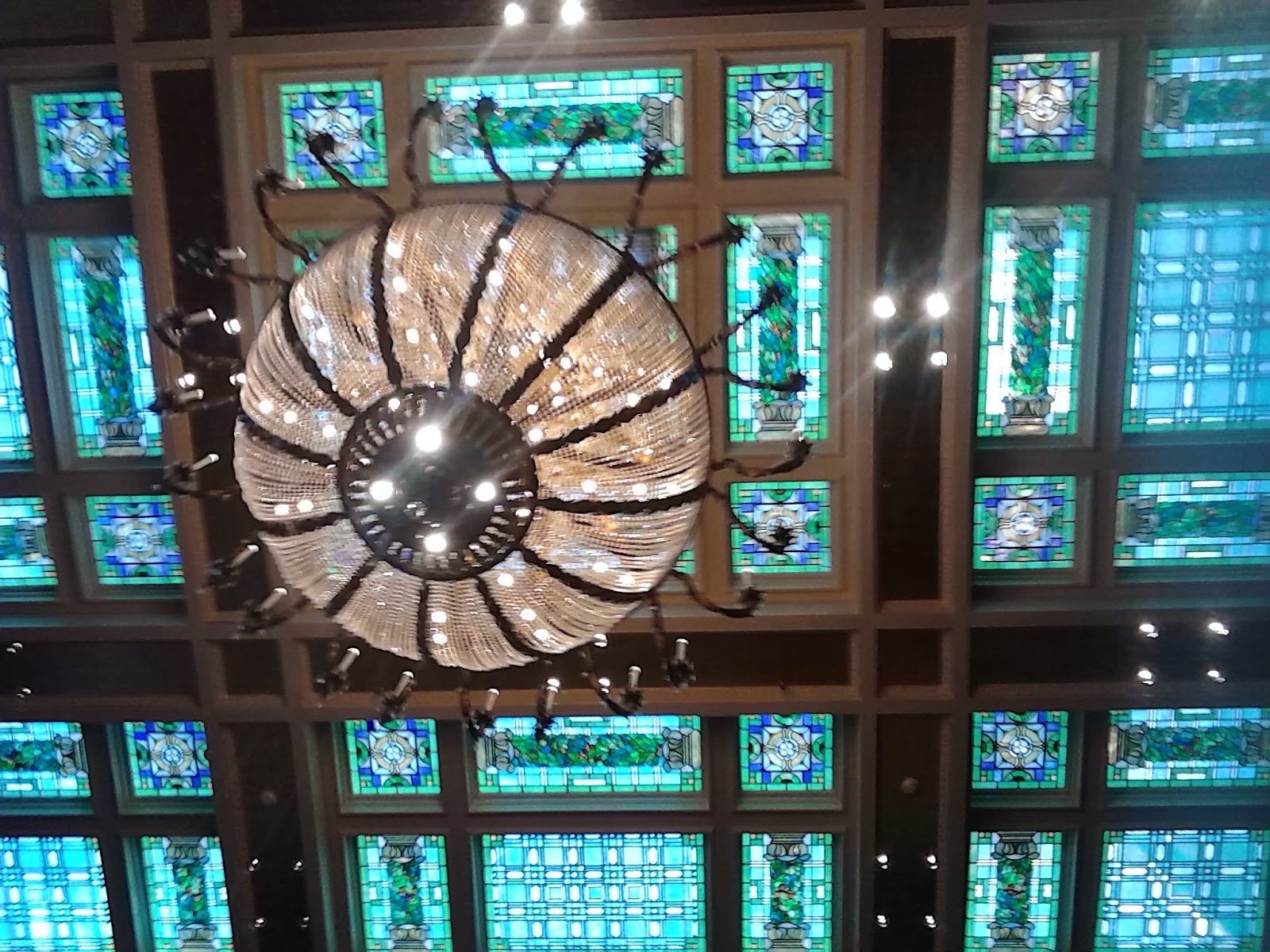
The chapel itself was the most beautiful Mormon chapel I've ever seen. It obviously used to be a ballroom. The room was white with green carpet and seats. The ceiling looked like something out of a baroque palace, and there were pilasters topped with gold and white fruits and golden leaves.

I got a good picture of the ceiling. I tried to get a good one of the chapel's pulpit, but I was trying to be discrete and it came out blurry. I am still sharing it, hopefully you can get the idea.


This chapel is atypical of LDS chapels. Most LDS chapels are whitewashed, have no decoration to speak of, no artwork on the walls, no crosses (Mormons don't like crosses. They see them as symbols of death and torture.), and no real accents of any kind. With a few exceptions, churches built in the second half of the twentieth century and beyond all follow the same sort of pattern. In fact, every church built within a certain decade will be built on one of several pre-approved floor plans. There isn't much diversity in LDS churches. They put all of their creative resources into their temples which are all different and filled with the finest materials the Church can provide.

The People:

This church was also atypical in another striking way. Mormon churches, especially ones here in Utah, tend to be filled with families with lots of children. Usually there are many children in Sacrament meeting, often being shushed by parents. This ward however only had a few families. This was a type of ward I had heard about growing up. They call this type of ward a "newly weds and nearly deads" ward. This is a very irreverent term for wards comprised mostly of elderly people and young newly wed couples who haven't yet had children.

This was first apparent to me when I saw few children or teens in the ward, and when I saw adult men preparing, blessing, and passing the Sacrament (Mormon communion). Typically, young men between 16 and 18 bless the Sacrament, young men between 14 and 16 prepare the Sacrament, and boys between the ages of 12 and 14 pass it to members of the congregation.

As far as the people and how they reacted to us, not one person in the ward approached any of us and talked to us. Only one person approached us, and that was an elderly missionary in the lobby of the building who basically wanted to make sure we weren't tourists and were there for the service. I got the impression we were being watched by several people in the congregation who all wanted to know why we were there.

There is no social hour after a Mormon service, nor before. Members of wards are pretty tight knit, outsiders visiting often feel like they're not welcome, though this isn't necessarily the case. Today, I did feel pretty unwelcome. It felt as though some of the older members in particular didn't really want us there.

The Service:

The service was very typical of an LDS service. They began with the bishop giving announcements. Then there was an opening hymn and a prayer. The woman who gave the prayer was clearly feeling it and not just going through the motions. I haven't heard a public prayer in a Mormon church before with such emotion behind it.

Afterward, they blessed and passed the Sacrament to the congregation. Mormon Sacrament consisted of sliced wheat bread torn into little bits and tiny plastic cups of water that could be disposed of. No, I didn't partake. Mormons practice closed communion and I am officially no longer a member of the Church.

Afterward, they opened the pulpit up to testimonies. More on that in "The Message" section.

After testimonies, they ended with a hymn and a prayer. I have never liked LDS hymns. The Mormon Tabernacle choir has lovely arrangements of these hymns, but the ones sung in Sacrament meeting are watered down, monotonous, and lifeless. Often it's hard to tell the difference between hymns. I would like to see more lively hymns in their church, which can be done in a traditional style still, as we see with the Mormon Tabernacle Choir.

Overall, the service left me wanting more out of it. It was very uninspired and unmoving to me.

The Message:

Here was where I had a few issues.

The bishop began testimonies by giving his testimony. He said a couple things that really bothered me. He talked about encountering Catholics on his mission when he was young. He mentioned that Catholics didn't read the Bible because they were taught not to and that it was forbidden by the Catholic Church and that a priest had to interpret it for you and give you the true meaning. This is a blatant lie. Catholics are not discouraged from reading the Bible. They are in fact encouraged to read it. As a Catholic convert, I was given a Bible to study, told to read it, joined a Bible study group offered by my parish, and Bible passages are read at every single Catholic service. The fact that this bishop, a man in a position of authority was making this claim to members who would readily and easily believe it really upset me.

He also said he read the whole Bible and found it very uplifting. I have a hard time believing he actually read it cover to cover as he mentioned if he found it uplifting. I have never met anyone who has done that and found the experience uplifting. It usually inspires many questions, doubts, and tests one's faith. Even the devout Christians who truly believe I know who have done so say it was a challenging experience but one that brought them to a level of deep faith. Not one person I've known has said it was uplifting, but they have all said it was rewarding in one way or another.

A lot of the testimonies were similar, sharing life experiences, people who clearly had fallen on hard times and needed the Church to give them meaning of it all or get through it, people who were grateful for what they had, etc.

One thing that really bothered me was the woman who brought her daughter up to bear her testimony. It bothered me as a Mormon, and it bothers me now. Children can't have a testimony of the Church and know it's true. They are small children. They don't understand what the Church is, what it really teaches, or the concept of belief and doubt. They simply parrot what their parents tell them to and this is wrong. Let the child be a child and discover what they believe and want as they grow up. Do not force them to make public statements of faith when they have no real concept of it.

Overall Experience:

I am glad I did this, because it allowed me to see some of my past. But I will not be returning to an LDS Church anytime in the near future. This was too hard for me and made me feel very awkward. I am not inspired by these services, and personally find them boring. I am glad that others find lots of meaning in them, but it is not something I could ever believe in again, and it is certainly not where I want to be.

Additional Comments:

I will be adding another blog sometime this week commenting more on my trip to Temple Square and the LDS Church in general. Join me for that.

Next week I will be going to the Community of Christ, formerly known as The Reorganized Church of Jesus Christ of Latter Day Saints.

Until next time. Peace be with you.

Wednesday, February 26, 2014

Returning to see the Latter-day Saints

This week, I'm returning to the church of my childhood, The Church of Jesus Christ of Latter-day Saints, commonly called the LDS Church or the Mormon Church. For those of you who don't know me and are just now reading my blog, I was raised LDS but left when I was a teenager. More on that later in this blog.

I am assuming many reading this blog are familiar with the LDS Church, but for those of you who aren't familiar, I will give a rundown.

The Church of Jesus Christ of Latter-day Saints has its roots in New York. A young man in 1830 named Joseph Smith Jr. founded a new religion called the Church of Christ. He claimed that he had received revelations from God to restore the primitive Christian Church that Jesus had founded but had been corrupted over the years by the teachings and ways of mankind. Over the next decade the Mormons, as they came to be called, were pushed from New York to Ohio, Missouri, and finally to Illinois.

While in Illinois, a newspaper called the Nauvoo Expositor published unflattering things about Joseph Smith. Joseph Smith had the newspaper shut down and destroyed. Joseph Smith was arrested for this and while in prison he was assassinated.

After the death of Joseph Smith, a large number of the Mormons followed a man they believed to be the successor to Joseph Smith, a man named Brigham Young, to the Salt Lake Valley where they established a territory called Deseret which later became the State of Utah.

Since then, the Church has grown to be a worldwide church boasting nearly 15 million members. The Church is well known in the world for its widespread missionary campaign, it's history with polygamy (more on that later), and being the faith of 2012 presidential candidate Mitt Romney.

Similarities between the LDS Church and Mainstream Christianity:
  • They believe Jesus Christ was the Messiah and atoned for mankind's sins.
  • They believe in the Old and New Testaments as inspired scripture for the teaching and betterment of mankind. Mormons use the King James Bible only.
  • They practice baptism which is done by full immersion in the name of the Father, Son, and Holy Ghost.
  • They believe in the inevitable Second Coming of Jesus.
  • They hold weekly meetings on Sunday in simple buildings called meeting houses which are open to the public.
  • They practice a form of communion called the Sacrament. They don't believe in any literal presence of Jesus in the Sacrament, but rather it is a symbol of remembering his death and resurrection, much like Baptists. For the Sacrament, Mormons typically use sliced, white bread and water.
  • They hold to a strict moral code like many Christians. This includes, no sex before marriage, no pornography, no masturbation, abstaining from alcohol and drugs, not using profanity, and not getting tattoos or body piercings.
  • Mormons have a very strong emphasis on family and family values. Like many Christians, the family is placed at the heart of their faith.
Differences between the LDS Church and Mainstream Christianity:
  • Mormons do not believe in the Trinity, one God in three persons, but instead believe the Father, Son, and Holy Ghost are three separate and distinct beings each being gods themselves.
  • God has a body of flesh and bone.
  • In addition to the Bible, Mormons also have three additional books they consider scripture
    1. The Book of Mormon. This is the book Joseph Smith claimed to have translated from golden plates he found on a hillside. This book is said to be a record of ancient Jews living in America in ancient times who are the ancestors of Native Americans today. This book contains many teachings of the LDS Church and has what they believe is a record of Jesus visiting the Americas after his resurrection.
    2. The Doctrine and Covenants. This book consists of records of the early days of the Mormon Church written by Joseph Smith or other key figures of the early Mormon movement. The majority of Church doctrines can be found in this book.
    3. The Pearl of Great Price. This book contains several additional writing of Joseph Smith.
  • They have a very different view of the afterlife than any other Christian denomination. After death, it is believed spirits go to the Spirit World which is either a paradise or prison for the spirits there. Then after the Last Judgment, humanity will be divided up and go to one of four places:
    1. The Celestial Kingdom, a kingdom ruled by the Father and filled with infinite glory
    2. The Telestial Kingdom, a kingdom ruled by the Son and filled also with glory, but diminished from that of the first kingdom.
    3. The Terrestrial Kingdom, a kingdom ruled by the Holy Ghost and filled with glory, but diminished from that of the first two kingdoms.
    4. Outer Darkness, a realm of eternal torment and pain reserved for the Devil and his angels, and those who denied the Holy Ghost. It's nearly impossible for living people to obtain this fate according to Mormon teachings.
  • They believe in modern day prophets which they believe speak directly to mankind for God.
  • They believe that those who obtain the highest level of the Celestial Kingdom will go on to become gods themselves of their own worlds.
  • They believe that families that are sealed together and live righteously will be together for all eternity.
  • They have temples which are open every day but Sunday. These temples are for members only and include three main ceremonies performed by worthy Mormons:
    1. Baptisms for the dead. Mormons practice proxy baptisms for those who died without being baptized into the Church. Mormons believe that those who have died can accept this baptism and change the fate of their souls in the afterlife.
    2. The Endowment Ceremony. In this ceremony, Mormons believe they are given special instruction and endowed with special blessings and covenants with God. It is considered one of the most sacred rites on Earth and necessary for the highest degree of glory.
    3. Temple marriage or Sealing. It is believed that only marriages performed in the temple are eternal. Couples who are worthy are married in a special ceremony in the temple for this life and all eternity.
  • The Church once practiced polygamy and was fiercely proud of it, however, in 1890, with much pressure on them from the federal government, a revelation was said to have been given to the President of the Church banning the practice of polygamy. Several sects, such as the Fundamentalist Church of Jesus Christ of Latter-day Saints (FLDS), have broken away due to this teaching and continue practicing polygamy. The Church is fiercely against polygamy today and this is a sore spot for many in the Church. Mormons, however, do believe that men can be sealed to more than one wife in the afterlife, but on Earth he can only have one at a time.
  • In addition to not indulging in alcohol and the like mentioned above, Mormons are also prohibited from drinking coffee and tea, and from partaking in any form of tobacco.
  • They believe we all lived before our lives here on Earth as spirit children in the presence of the Father. 
I am going to a special service held every month called Fast and Testimony Meeting. This is like a normal weekly meeting with the Sacrament, but instead of talks, members get up and bear their testimony of the Church, declaring publicly that they know it is true and explaining why or giving a story that reinforced their testimony. The 'fast' portion comes from the fact that on the first Sunday of the month, Mormons are supposed to fast from the night before until dinner time Sunday evening and give the money they would have spent on food to the Church for those in need.

I have to now admit that I left the Church in my mind when I was 17 and publicly left when I was 18. So, to reveal my age, this May will be the 10 year anniversary of me leaving the Church publicly. In my 10 years outside the Church, I have only entered an LDS church three times, once for my sister's baptism, once for my nephew's baby blessing, and once for my friend's wedding. Aside from that, I've avoided going because I have a lot of emotional baggage with the Church. Being around all things Mormon actually stirs up a lot of unresolved issues that I have with the Church. It brings up years where I felt I was systematically lied to from the highest levels; years of shame and guilt that they made me feel; all the times I cried to God for help or to be someone else, but he never came; all the times I asked questions and was turned away; all the feelings that I was a hypocrite and a monster; and ultimately, the feelings of betrayal that I experienced by people who were very close to me when I left.

I am going to try as hard as I can to remain objective in this week's blog. I am going to treat this service like any other service I go to and keep my own personal feelings out of it. The same rules that applied to other churches apply to this one. I will not make a scene, and I will be fair and simply report on my experience in this blog. This also means that I will not cater to my Mormon friends and family and just give them a good rating so that I don't step on toes. This service is to be just like any other one. Therefore the good, the bad, and the ugly of the service are all equally fair game, though I will not let my own bias get in the way.

The place I have chosen to attend should give me one of the most beautiful experiences I could have in a Mormon service. We are going to go to the Joseph Smith Memorial Building, which is in Temple Square, the epicenter of the Church. I'm looking forward to seeing what it's like there, and hopefully this experience is a pleasant one for me.

Until I talk to you next, peace be with you.